


 Share on media



If you work in the IT industry, you have probably heard developers talk about “doing katas.” If you have ever wondered what that means, you are in the right place. Coding katas are small, repeatable programming exercises designed to sharpen coding, problem-solving, and software design skills through deliberate practice. Much like a martial artist repeating the same movements until they become natural, developers use katas to build better coding habits over time. The concept has spread across many platforms, making it easier to find Best Coding Kata Sites for regular practice and skill development.
Why Are Coding Katas Important?
Coding katas is significant because they allow programmers to fine-tune their capabilities and become more comfortable with fixing issues. By regularly solving katas, developers can:
- Enhance Problem-solving: Get the capability to break down issues and find effective solutions.
- Master Algorithms: Practice algorithms that are asked commonly in interviews.
- Establish Confidence: Improve your confidence in coding by consistently solving easy problems.
- Boost Speed: Boost efficiency and coding speed as you gain familiarity with exercises.
What Are the Factors That Make a Good Kata Site?
Before you review the list, let us check out the important factors that separate effective Kata platforms from generic sites with coding challenges:
- Bite-sized problems that can be solved in 15-60 minutes.
- Progression or ranking system that monitors improvement over time.
- Community solutions that you can study after solving issues.
- Variety of difficulty levels vary between new to advanced.
- Numerous Language Support enabling practice in your chosen language.
As per these criteria, let us explore the best platforms for training:
Common Mistakes You Can Avoid While Practicing Coding Katas
Katas only work if you practice them in the right way. Some habits slowly affect your progress, even for developers who show consistency daily:
- Ignoring Community Solutions after Finishing: The greatest learning gain on tools such as Codewars generally comes after you are done with Kata, not during. Immediately closing the tab implies missing alternative solutions you have not considered.
- Mindlessly Chasing Instead of Comprehension: Speeding up to 1-kyu or collecting streaks can be extremely motivating. However, solving 50 katas without understanding why a certain solution works builds you false confidence. The focus should be on developing real skills.
- Only Choosing Problems You Are Good at Already: It is tempting to remain in your comfort zones (arrays, if that is your strong area) and ignoring categories like recursion or data structures where you are not really strong. Progress happens when you come out of your comfort zone and work on your weak areas.
- Skipping Edge Cases Once You Pass the Test: A kata that passes its visible test cases is not solved well really. Develop the habit of asking what kind of conditions can break your solution before you move forward.
- Never Repeating Old Katas: The original Codekata philosophy of Dave Thomas was developed on solving the same problem multiple times with distinct approaches. Most developers just focus on solving a kata once and often, they do not return to it. They miss out on developing skills where they learn to approach the same problem differently.
- Working Independently When Stuck with a Problem: If you are stuck with a problem at a best coding kata sites well beyond its usual time estimate, it is generally more beneficial to talk to elsewhere. Our detailed roundup of the Best Coding Forums to Join in 2026 encompasses communities where you can explore logic and approach, not just a copy-paste solution.
Avoiding such patterns is what separates engineers who do not develop their skills after a few hundred katas from the ones that keep on improving.
Top 7 Best Coding Kata Sites in 2026
1. AlgoCademy (The Right Place to Begin):
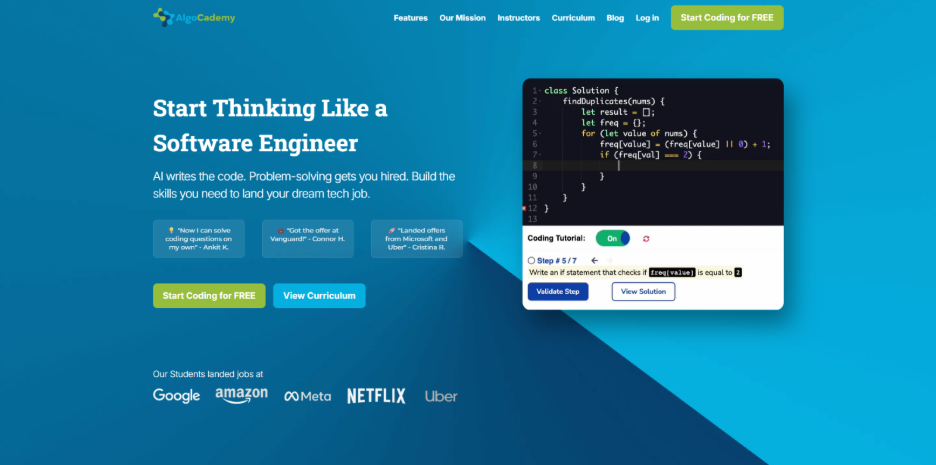
While websites such as Codewars present complex issues without guidance, AlgoCademy utilizes a step-by-step and interactive IDE that pushes you to emphasize code quality, not just passing code quality, not just test passing. It works as a simulator for a senior engineer’s mind.
Why Is It Different? Instead of fixing isolated issues in a vacuum, you work through guided tutorials that explicitly teach problem-solving patterns. The problem breaks complex issues into simple and manageable steps.
How AlgoCademy Operates?
Step 1: Write empty for loop with appropriate syntax. This validates before going ahead.
Step 2: Add an if statement inside the loop. This checks the logic.
Step 3: Executes the conditions to process the element. This ascertains comprehension.
Step 4: Add a return statement outside the loop. This validates completion.
This is an incremental approach that makes sure that you comprehend every component before heading down to the next. The AI tutor gives you hints without any spoilers. When you are stuck just staring at the blank screen instead of jumping to the solution directly, you get smart nudges that help you think through the problems.
Right Feature: The platform makes learning a lot more engaging. Instead of dry error messages, you get gamified progress (including cat memes) that ensures motivation while learning complex syntax. The platform monitors completion rates, and 43.7% of paying users complete full courses. This substantially improves the completion rate in digital education.
The Learning Approach: If you practice Codewars Katas but still face issues when facing new issues, you might be missing out on underlying issues. AlgoCademy explicitly teaches such patterns via interactive exercises that build upon each other. It is specialized for the moment when you fix simple issues, but medium-level difficulty problems remain challenging.
Interactive Coding Tutorials: Every lesson introduces a few coding issues that must be finished in sequential steps. You cannot proceed to step 3 until step 2 is implemented correctly. This organized progression avoids the common issue of copying pasting solutions without comprehension. The system verifies every step before enabling progression, ascertaining progression at each level.
Downsides: The problem library is quite smaller when compared to Codewars (300 lessons versus 10,000+ katas). There is less pure gamification when compared to conventional kata websites. If you want just a 15-minute kata practice session, Codewars may become a lot more suitable.
Best for: Self-taught developers and beginners who find LeetCode frustrating and wish to understand the reasoning driving the code. This is also suitable for developers who are preparing for technical interviews and need guided learning instead of problem sets.
Complete Transparency: This article was generated by the author of this article. However, it was established because way too many developers are practicing hundreds of problems without visible improvement. Sometimes what is required is not just practice, but better practice with more organized guidance.
2.Codewars:
The original platform that remains extremely popular. Codewars invented the concept of coding kata online, and for practicing problems, it remains a great standard:
Why Is It Popular? The 8-kyu to 1-kyu ranking system is extremely motivating and effective. Users begin as 8-kyu beginners, and every solved kata earns you honor points toward ranking up. The most crucial feature happens after submission: you can see how hundreds of other developers have solved the similar issue, often utilizing approaches you might not have considered. A lot of developers have reported that they have learnt more JavaScript techniques from reading Codewars solutions than from conventional tutorials.
The Kata Library: More than 10,000 challenges across more than 55 programming languages. The difficulty varies from standard string manipulation to problems needing advanced algorithmic insights. The community consistently creates new katas.
When Should You Use it? You can learn basic patterns from AlgoCademy and then apply the knowledge to Codewars. It works as the practice arena where you develop fluency and repetition.
Downsides: A few community-based Katas have inadequate or unclear test cases. It also has inconsistent difficulty ratings: one 5-kyu problem might need 20 minutes while another one at the same level might need 2 hours. If you already do not know how to approach a problem type, Codewars will not give you instruction on the core concepts.
Best for: Developers with basic knowledge at any level of skill. Irrespective of whether you have been coding for decades or learning your first knowledge, Codewars can provide you with relevant challenges. However, it is significant to have established fundamentals before starting.
Price: Free (Premium tier removes advertisements and includes additional features, but the free version is completely functional).
3. Exercism:
Exercism takes a distinct approach by integrating human mentorship. You work on exercises, solve them, submit them, and mentors volunteer to review your code and recommend enhancements.
Why Is It So Effective?- The focus goes beyond functionality and reaches idiomaticity and quality of code. If you are practicing coding on Python, mentors will educate you to create Pythonic code, including generators, list comprehensions, and effective naming conventions. This is crucial for creating code of professional quality, not just the code that can be passed in tests.
The Exercise Library: 70 languages are combined with 20-100 exercises each. The exercises are often simpler than Codewars katas but more optimized on language-specific right practices and conventions.
Downsides: Mentor availability changes drastically. Feedback can come within hours or might take several days. The problem is algorithmically challenging when compared to other platforms. The platform focuses on learning how to write idiomatic and clean code instead of solving tricky algorithms.
Best for: Developers learning a new language program and want to write professional and idiomatic code from the start of their professional journey.
Price: Free-of-cost (open-source platform with mentors who volunteer)
4. Edabit:
Edabit is specifically designed for absolute beginners. If even the detailed approach of AlgoCademy can feel a little overwhelming. The platform ensures even a gentler beginning point:
Why It Works? The difficulty curve proves to be more gradual than different platforms. Problems start with standard operations such as returning the sum of two numbers and increases in complexity gradually. The achievement badges and XP system aid in ensuring motivation during the initial phase of learning.
The Library: 10,000+ challenges. However, most of them are tilted more toward simpler problems. A lot of them can be solved in less than 10 minutes.
Downsides: Users generally outgrow this platform quickly. Within just a few weeks of consistent practice, the problems might feel a little too easy. There is no system of mentor feedback, and the community solutions are not as complete as the ones found on Codewars.
Best for: Total beginners who have completed their first programming tutorial and require low-stakes practice before taking on more organized platforms.
Price: Free (Premium tier adds additional characteristics)
5.Codekata:
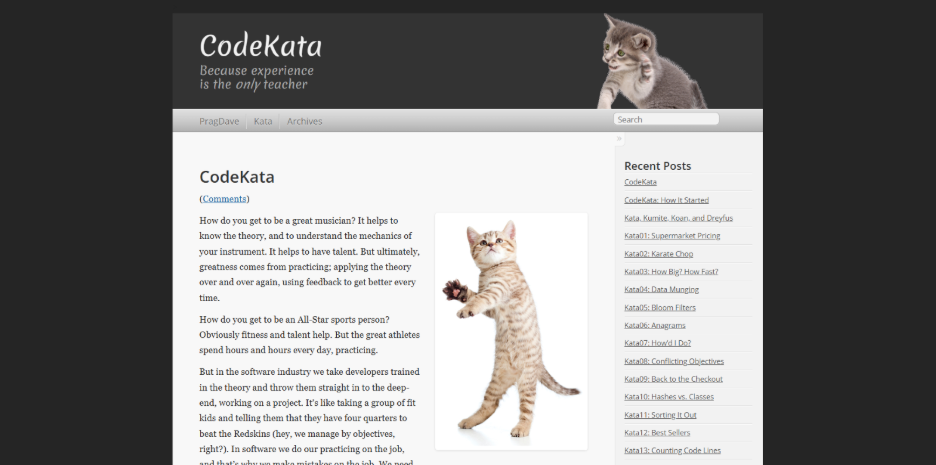
Dave Thomas, who is the author of The Pragmatic Programmer, created the original concept of Kata coding, and Codekata is his collection of 21 exercises. These are not part of an online platform but are rather a hand-picked set of problems with essays explaining the core philosophy behind each deliberate practice.
Why Is It Important? Such katas are created for repetition. The goal should be to not just solve them once, but to solve them numerous times using distinct approaches and exploring alternative solutions. Kata14 (Tom Swift Under the System of Alarm) is a classic exercise that numerous experienced developers can suggest.
Downsides: The total number of katas is only 21. There are no community features, no online platform, and no ranking system. You can solve such exercises in your own development or IDE environment.
Best for: Experienced developers who want to comprehend the philosophy of deliberate practice simply beyond solving a high number of problems.
Price: Free
6.Cyber Dojo:
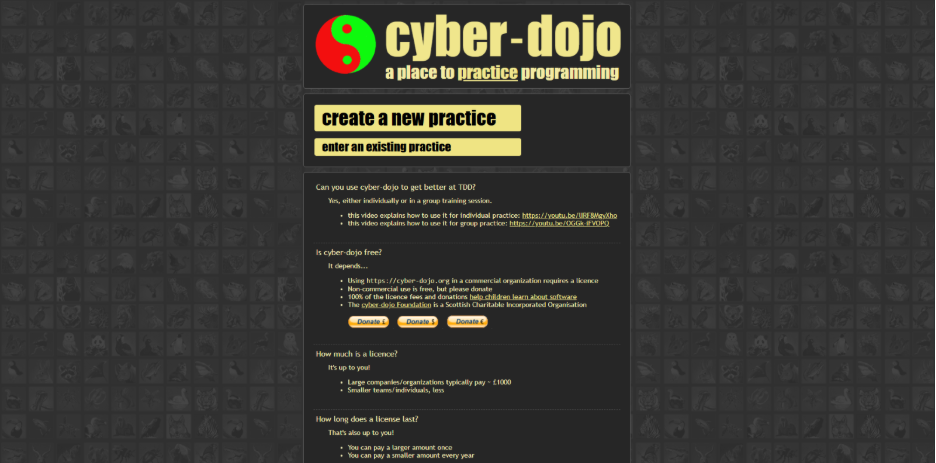
It is a dedicated platform for practicing kata exercises with a greater focus on Test-based deployment. Here, each test needs you to write exercises first, then execute the solution:
Why Is It Unique? The platform helps you visually track red-green-refactor cycles. You can see how frequently you ran tests, how your solution changed with time, and perform comparison of your TDD rhythm with other users. It encourages you to adopt good habits of development instead of just problem-solving.
Downsides: The user interface is intentionally minimal and appears dated somewhere. There is no ranking system or gamification. If you do not have an interest in TDD methodology, you will find very few reasons to choose this over Codewars.
Best for: Developers who wish to enhance their TDD discipline and systematically practice red-green-refactor cycle.
Price: Free
7.Coding Dojo Kata Catalogue:
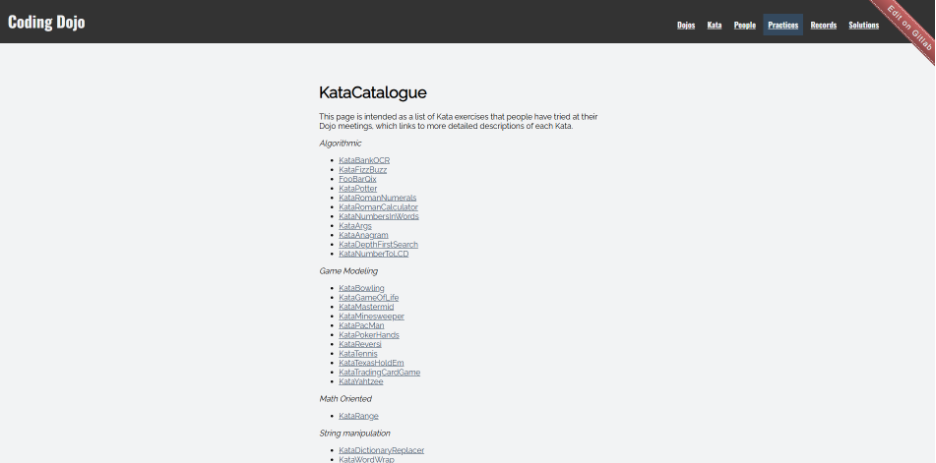
This should not be confused with coding bootcamp with the same name. This is a catalogue of classic programming katas maintained by community with links to resources and descriptions.
What It Is? It is more of a directory than a platform. It mentions the lists of well-known katas like Bowling Game, FizzBuzz, Mars Rover, and Roman Numerals with links to in-depth instructions. You can easily solve such exercises in your own environment of development.
Why Is It Useful? This is beneficial when you want focused practice on a particular type of problem without platform gamification overhead. Specifically valuable for coding dojos (group practice sessions) or pairing exercises in team settings.
Downsides: No test cases are provided, no online platform, and no community solutions. You are responsible for creating your own validation and runtime environment.
Best for: Team leads planning group practice sessions or developers who need to solve problems in their local development environment.
Price: Free
Coding Katas vs. Technical Interview Prep: Where Each One Helps
It is quite easy to assume that preparing for interviews and kata practice are the same thing. However, they are actually created for distinct outcomes:
| Criteria | Coding Katas | Interview Prep (e.g., LeetCode-style) |
| Primary goal | Develop speed, fluency, and clean habits of coding. | Practice particular concepts, topics, and algorithms that you might expect in interviews. |
| Time pressure | Low because it is created for repetition and not races. | High as emulated timed conditions as you expect in interviews. |
| Problem style | Varied, short, and generally not dependent on language. | Structured around algorithm categories and data structures. |
| Best used | Ongoing and daily skill maintenance. | It focuses on blocks ahead of interview cycles. |
Best coding Kata sites should be considered as resources for strength training. They ensure that your basics remain sharp throughout the year. Dedicated interview preparation is much closer to a training camp before a particular event. Developers who depend only on Katas often struggle with patterns specific to interviews such as optimizing for time complexity under pressure, while developers who only focus on preparing for interviews build a habit of writing brittle code that breaks outside the specific problem format. Utilizing both and on rotation tends to create more well-rounded outcomes than just choosing one.
Developing a Daily Kata Habit That Sticks with You
Consistency should be prioritized over intensity while solving katas. However, most people forget about this habit just after a few weeks. A routine that can benefit you over time often involves:
- Time-boxing Sessions to Around 15–30 minutes: Katas are supposed to be short session. Stretching them into an hour-long session leads to burnout quickly than skipping days completely.
- Deliberately Rotating Difficulty: Create a good mix by adding a kata you are comfortable with to create momentum and also the one that is hard to strengthen your ability, instead of always choosing the one that is easy.
- Document What You Solved and How You Solved It: Create a simple running note of the kata, include your approach, and one thing you would do different ensures a feedback loop that pure repetition does not.
- Attach it to a Current Habit: Practicing one right before you open an email to right after your daily standup makes it easier for you to sustain this habit than depending on your willpower alone.
- Review Each Week Not Daily: Once every week, revisit two or three older katas and do not look at your previous solution. This is how you can boost your retention power.
A habit that you can sustain over a busy week is more helpful than an intense streak that quickly burns out by the second month.
How Coding Katas Help With Web Development
Coding katas are not limited to algorithm practice or technical interview preparation. The problem-solving habits developed through regular kata practice can also support web development, especially when you need to understand code, troubleshoot errors, and build features systematically.
Practice JavaScript Logic
JavaScript is commonly used to create interactive elements on websites. Coding exercises involving conditions, loops, arrays, functions, and objects can help you become more comfortable with the logic required for interactive web features.
Strengthen Debugging Skills
Web development often involves finding problems that are not immediately obvious. A coding kata encourages you to test assumptions, identify errors, examine edge cases, and improve your solution. These same habits can be useful when troubleshooting frontend or backend issues.
Improve Code Structure
Regular kata practice can help you recognize when code is becoming unnecessarily complicated. Learning to break problems into smaller functions and organize logic clearly can make website code easier to understand and maintain.
Connect Programming With WordPress Development
WordPress developers can benefit from programming fundamentals when working beyond standard settings. HTML and CSS are useful for frontend changes, JavaScript can support interactive functionality, and PHP is important when working with WordPress themes, plugins, and custom features.
Coding katas should not replace real website projects, but they can strengthen the programming fundamentals that make web development easier to understand. Combining short coding exercises with practical development projects gives you opportunities to apply what you learn in a real environment.
Build a Portfolio That Reflects Your Coding Skills
Completing coding katas is a great way to sharpen your technical abilities, but showcasing those skills is equally important. A personal portfolio allows you to display projects, explain your coding process, and demonstrate your progress to recruiters or potential clients. It also gives you a space to share tutorials, coding tips, and solutions you’ve developed along the way.
If you decide to build your portfolio with WordPress, pay close attention to your website’s design and performance. Selecting a lightweight, responsive WordPress Theme can improve loading speed, create a better user experience, and make your content easier to navigate. A professional-looking website not only highlights your programming skills but also strengthens your personal brand as you continue learning and growing as a developer.
From Coding Katas to Real-World Development Projects
Solving coding katas gives you a controlled environment for practicing programming concepts, but real development requires you to combine those skills with larger projects. Moving from individual exercises to practical projects can help you understand how programming concepts work together outside a testing environment.
Start With Small Features
Instead of immediately attempting to build a complete application, start with a small feature. You could create a form validation system, calculator, search function, interactive component, or simple API integration. These projects allow you to apply the same problem-solving approach used during kata practice.
Combine Multiple Programming Concepts
A single coding kata may focus on one particular problem, while a real project can require several concepts at once. You may need to work with functions, data structures, APIs, databases, frontend code, and error handling within the same project.
Apply Debugging Techniques
Real projects rarely work perfectly on the first attempt. When something fails, use the same process you developed through kata practice: reproduce the issue, identify the relevant code, test possible solutions, and verify the result. This approach can make debugging more systematic.
Apply the Skills to WordPress Projects
If you work with WordPress, programming knowledge can be useful when customizing websites or investigating technical problems. Depending on the task, you may work with HTML, CSS, JavaScript, PHP, APIs, or database concepts. Understanding the fundamentals can help you make more informed development decisions.
Keep Practicing While Building
Real projects should complement rather than replace coding practice. You can continue solving a few katas each week while working on a website or application. This gives you both focused programming practice and experience applying those skills to larger development tasks.
The goal is not simply to complete as many katas as possible. The more useful outcome is being able to take the problem-solving, debugging, and coding habits developed through practice and apply them when building something real.
Conclusion:
Selecting the best coding kata platform relies on your present skill level and objectives. Beginners start from AlgoCademy or Edabit, while intermediate developers excel on Codewars. Exercism suits the ones that are mastering a new language, and Cyber Dojo is the right option for TDD-focused practice. For philosophy-based deliberate practice, Coding Dojo Kata Catalogue and Cyber Dojo always remain go-to resources. Consistency is more crucial than platform choice. You need to choose one, practice regularly, and explore more platforms as your skills evolve.
If you are looking for way to upgrade your programming skills, then you should further read our blog: 15 Top Programming Tutorials to Learn Coding Faster
FAQs :
What are coding katas, and why are they useful?
Coding katas are small, repeatable programming exercises designed to improve problem-solving, coding speed, debugging, and algorithmic thinking through regular practice.
Which coding kata site is best for beginners?
AlgoCademy and Edabit are good choices for beginners because they offer easier exercises and a gradual learning experience before moving to more challenging coding problems.
Is Codewars good for improving coding skills?
Yes. Codewars offers a large collection of challenges across many programming languages, along with rankings and community solutions that can help developers learn different approaches to solving problems.
Which coding kata platform is best for learning a new programming language?
Exercism is a strong option for learning a new language because it combines language-specific exercises with feedback from mentors and a focus on writing clean, idiomatic code.
How often should you practice coding katas?
Consistent practice is more important than completing a large number of exercises quickly. Solving a few katas regularly and revisiting problems with different approaches can gradually improve your coding and problem-solving skills.