


 Share on media



About 46% of all the Google searches globally seek local information. This factor indicates that the local search optimization is not just a niche strategy but is transforming into mainstream search behavior. For businesses operating on WordPress, relying on generic site structures is a missed opportunity. The research also shows that approximately 76% of all consumers conducting a local search on their mobile devices have visited the physical business location withing the next 24 hours. To capture this high-intent traffic, the WordPress website must be meticulously structured for local search dominance, ensuring that the digital storefront act as an inviting and accessible to the users.
Establishing Your Technical Foundation
Before users can effectively implement the geo-tagging or any other complex local schema, it is essential to establish a rock-solid base of the website. In WordPress, a sluggish or poorly coded theme will also undermine even the advanced local campaigns. The first steps the user needs to do is to ensure that the site has a strong baseline of performance and crawlability. Implementing advanced SEO techniques is the crucial first step to ensure fast loading speeds, clean architecture, and proper indexing. Various other factors, such as a cluttered database, outdated plugins, or excessive redirects can also significantly hamper how the search engines crawl the content, making technical hygiene a non-negotiable priority.
Once the baseline elements, such as semantics content clustering and Core Web Vitals are addressed, users can start layering on location-specific strategies. In the highly competitive market like Australia, the local businesses generally target multiple locations or specific service areas, that can drive up to 557% more organic traffic on an average, compared to a single-location website. Managing this complex architecture often requires expert guidance. For a growing multi-location business, partnering with a local SEO agency in Sydney can ensure their complex site architecture accurately reflects their service areas across different suburbs without cannibalizing their own search rankings.
Aligning with Core Local Search Dominance

To truly local search dominance results, you must understand how algorithms evaluate local relevance. Search engines look closely at your website data to verify your physical presence and authority within a specific geographic area. The official guidelines state that there are distinct tips to improve the local ranking on Google, which can confirm that the results are primarily determined by three major factors: relevance, distance, and prominence. Understanding each factor helps users boost their local dominance and explore how each factor interacts is the key to outranking local competitors.
Beyond ranking in local search, many businesses now pair this visibility with location-based marketing technology like geofencing to re-engage nearby customers in real time.
Translating these factors into the WordPress site structure also requires deliberate planning. For which the user needs a dedicated location page, consistent name, address and phone number data in the footnotes. When businesses need to scale their digital footprint beyond a basic do-it-yourself tweak, they can seek professional management to maintain consistency across all their digital touchpoints. This includes ensuring your Google Business Profile is seamlessly integrated and embedded via Maps APIs on your WordPress site.
Deploying Local Schema for AI and Voice Search
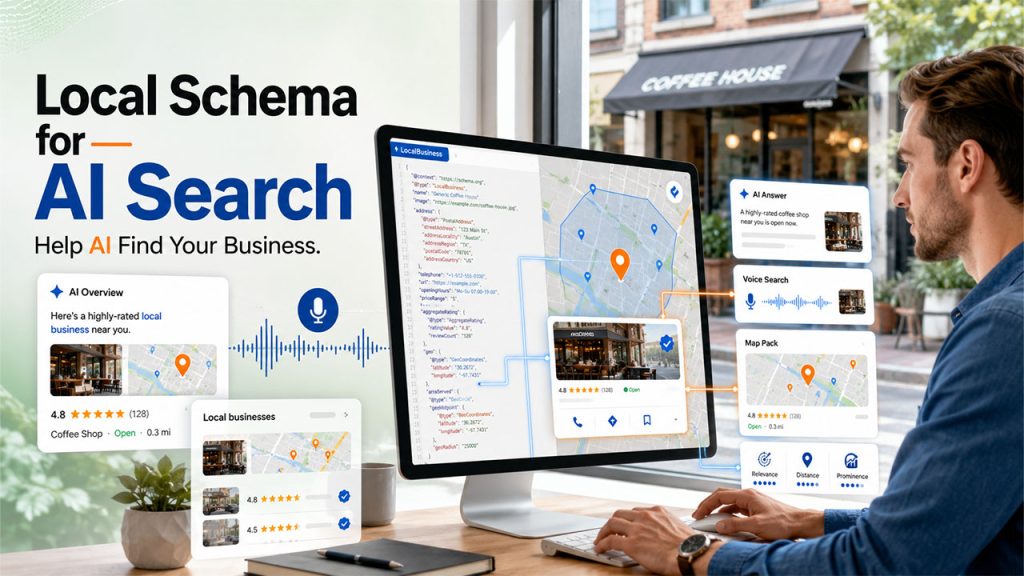
As of 2026, search algorithms are increasingly relying on artificial intelligence to process user queries. High-intent, location-based searches are frequently being answered by AI overviews. Because of this, standard organisational schema is no longer sufficient. Properly configured LocalBusiness schema is now a strict prerequisite for visibility. Artificial intelligence engines parse structural data to formulate direct answers, meaning any ambiguity in your code can result in a loss of rankings.
Roughly one-third of Australians utilise voice search daily, often phrasing queries as natural language questions. By using specialised WordPress plugins like Yoast Local SEO or Rank Math, you can output precise JSON-LD structured data. This allows search engines to verify your business details without guessing, securing your place in both traditional map packs and AI-generated citations. If you run a service-area business, you must implement dedicated Service Area schema alongside your core markup to accurately define your coverage. Structured data acts as a direct line of communication to search engine algorithms, making it an indispensable part of modern technical optimisation.
Prioritising Mobile Experience and Speed
Mobile performance is arguably the most critical component of local search dominance. Over 88 percent of all “near me” queries occur on mobile devices. A slow mobile experience actively repels ready-to-buy local customers who are looking for immediate solutions. As mobile-first indexing is the absolute standard, desktop-only optimisations are no longer viable.
To optimise your WordPress site for mobile local search dominance, consider the following structural adjustments:
- Optimise load times: A mobile page load time of just five seconds can increase bounce rates by 90 percent compared to a one-second load time. Sub-second loading speeds are the new industry standard, often achievable through premium caching plugins and dedicated hosting environments.
- Implement click-to-call functionality: Up to 60 percent of mobile users attempt to contact a business directly from local search results. Ensure phone numbers are easily clickable buttons rather than plain text, which eliminates friction for the user.
- Streamline mobile navigation: Local search dominance often have high purchase intent, with 28 percent of these queries resulting in a direct transaction. Make sure your contact page, booking forms, and location details are accessible within one tap from the mobile menu (often referred to as a “hamburger” menu on mobile devices).
Structuring the WordPress website for local search dominance also generally requires a blend of technical performance, along with accurate data structuring and a frictionless mobile experience. By aligning the website with the core ranking factors also ensures a rigorous mobile performance, along with meeting the modern schema requirements, ensuring that the businesses can effectively capture high-intent local traffic. Implementing these foundational strategies will ultimately help you turn nearby searchers into loyal, long-term customers.