

 Share on media
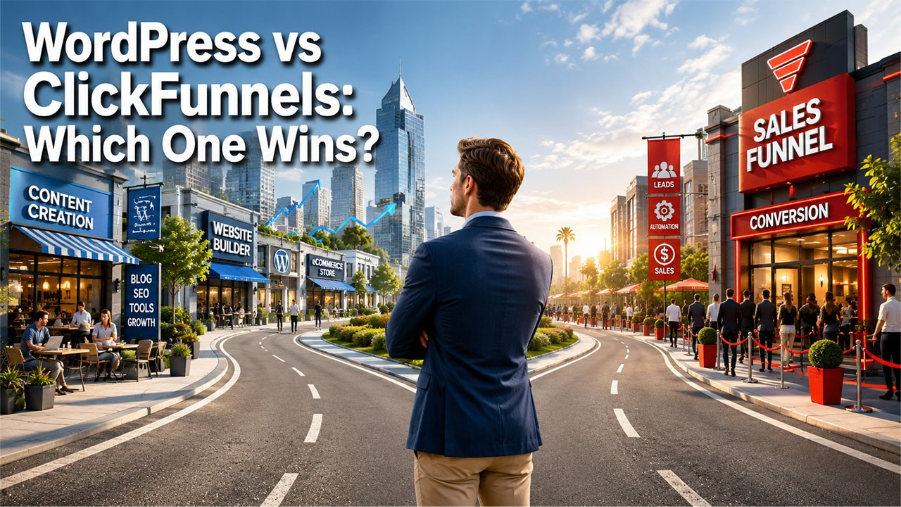
The best platform isn’t the one with more advanced features; it’s the one that actually fits what you’re trying to build. WordPress vs. ClickFunnels isn’t a contest between two equals trying to do the same job. It’s more like comparing a Swiss Army knife to a high-powered drill. They both are useful, but for very different reasons. So, before you invest your time or money into either one, let’s shed some light on each aspect of both tools.
What Are These Platforms, Really?
WordPress is an open-source content management system (CMS) that runs over 43% of all websites available on the internet today. However, it started as a blogging tool and gradually developed into a full website-building platform, with tons of plug-ins. It helps you build anything, right from a simple blog to a massive eCommerce store.
ClickFunnels was built to turn your visitors into buyers through its sales funnel builder. This funnel comes with pre-designed funnel templates, email marketing tools, a checkout system, and an online course builder, all under one roof.
If we try to understand both in a very simple way, then assume WordPress is like a blank canvas with thousands of tools to paint whatever you want. On the other hand, ClickFunnels is like a pre-built gallery specifically for selling.
WordPress vs. ClickFunnels Pricing, Who Wins on Cost?
This one isn’t close.
WordPress itself is free, but you pay for hosting (roughly $5–$20/month with providers like SiteGround or Hostinger), a domain (around $15/year), and any premium plugins or themes you choose. A solid WordPress sales funnel setup with tools like CartFlows or FunnelKit can cost under $200/year total. The hosting plan you pick plays a big role in that total cost, which is why WordPress Hosting vs Shared Hosting is worth understanding before committing.
ClickFunnels starts at $147/month on its Basic plan. That’s $1,764/year just to begin with. The Pro plan jumps to $197/month, and the Funnel Hacker plan hits $297/month.
| WordPress | ClickFunnels | |
| Starting Cost | ~$5/month + free core | $147/month |
| Annual Cost (Basic) | ~$150–$250/year | ~$1,764/year |
| Free Trial | Free forever | 14 days |
| Ownership | You own everything | Platform-dependent |
The trade-off is time vs. money. For instance, if you choose WordPress, it costs you less but requires more setup work upfront. ClickFunnels asks for a big month every month, but since it is already well-designed, you can quickly start using it for a sales funnel. If you run a small business or start-up with a tight budget, WordPress pricing makes far more sense in your case.
Ease of Use, Which One Is Actually Simpler?
WordPress Ease of Use
WordPress has a learning curve, no question about that. You need to pick a hosting provider, install WordPress, choose a theme, install plugins, and then figure out how they all work together. For someone with zero tech background, that process can be very time-consuming and may leave you feeling overwhelmed. But once you get past the initial setup, the day-to-day becomes quite smooth. The editor feature is simple to use, and most premium themes like Divi or Astra include drag-and-drop builders. Those still deciding between a builder and WordPress’s native editor will find the WordPress vs Elementor comparison directly relevant.
Funnel plugins like FunnelKit or CartFlows allow you to build sales funnels inside your dashboard. The effort you put in at the beginning will pay you off in the long run, in the form of more flexibility and control.
ClickFunnels Ease of Use
ClickFunnels wins on speed and does not require you to have a tech background to set up. You sign up, pick a funnel template, customize it with a drag-and-drop editor, and you’re live. That’s it.
Everything is already connected: the funnel, the checkout, the email follow-up sequence. You can easily launch a sales page or a lead generation funnel anytime without hiring a developer.
The downside? It has its own ecosystem, and once you are locked into it, you may feel stuck if ClickFunnels doesn’t support any particular feature you need.
Customization and Flexibility, No Contest
WordPress gives you next-level customization flexibility because it has 60,000+ plug-ins and thousands of themes. There’s almost nothing you can’t build using WordPress. Want a membership site? There’s a plugin. Need a custom checkout flow? There’s a plugin. Want to add a community forum, a podcast feed, or a multilingual site?
However, ClickFunnels offers limited customization. You work within their templates and tools. The design editor is solid for funnels, but you can’t step outside the ClickFunnels box without breaking things.
If you have a team of developers and designers on your side, WordPress is a great choice to go with. It also allows custom CSS and PHP modifications. ClickFunnels has a Liquid Theme Editor on higher plans, but that’s still a limited customization option compared to what WordPress offers.
SEO Capabilities, Which Platform Gets You Found on Google?
Search engine optimization is a long-term strategy that keeps updating over time. And WordPress fits well because of its endless customization options, and clearly stays ahead of ClickFunnels in this aspect.
- WordPress integrates with tools like Rank Math and Yoast SEO, both of which give you full control over meta tags, sitemaps, schema markup, and page speed optimization.
- You can build a content-rich blog, create internal linking structures, and run a full content marketing strategy alongside your funnels.
- ClickFunnels offers basic SEO settings like page titles and meta descriptions, but there’s no blog depth, no advanced schema support, and no serious content marketing infrastructure, which is needed for SEO and online marketing.
If traffic matters to your business, ClickFunnels is simply not built for that. It’s optimized for paid traffic, not search traffic.
eCommerce Features, Selling Products Online
WordPress + WooCommerce
WooCommerce is the most widely used eCommerce plug-in in the world, and it’s built specifically for WordPress. It supports:
- Physical and digital products
- Multiple payment gateways (Stripe, PayPal, and more)
- Subscriptions, bundles, and upsells (with add-ons)
- Full design control over product pages and checkout
Your developers can build a full store with complex catalogs, discount rules, and inventory management without spending much, usually just the cost of a few plug-ins.
ClickFunnels eCommerce
ClickFunnels can handle eCommerce, but it was built around funnels, not stores. Selling one product or a small lineup through a guided flow? It does that well. One-click upsells and order bumps are straightforward to set up and actually work nicely.
However, building a large-scale product catalog or a traditional online store isn’t what ClickFunnels was designed for. The shopping experience feels limited compared to WooCommerce’s full-store capability. So, if you have a limited catalog, you can stick with it, but later, as you scale, you will have to switch to WooCommerce’s full store.
Security, Who Keeps Your Site Safer?
ClickFunnels is a SaaS platform, which means it takes care of all your security needs. SSL certificate protection, server management, and even platform upgrades are not issues for you.
WordPress security becomes your responsibility. If your website is not managed, then it is vulnerable to attacks. Using Wordfence, Solid Security, or Cloudflare will protect your WordPress website.
If you are a beginner and don’t want to deal with hosting or technical setup, ClickFunnels offers peace of mind. But if you are comfortable with basic site maintenance, WordPress is completely secure when set up correctly.
WordPress vs. ClickFunnels for Specific Use Cases
Not every business needs the same thing. Here’s a quick breakdown:
- Bloggers and content creators: WordPress, without a doubt. ClickFunnels has almost no content publishing infrastructure.
- Course creators and coaches: Both work, but ClickFunnels is more plug-and-play. WordPress with a plugin like LearnDash gives you more long-term control.
- eCommerce store owners: WordPress + WooCommerce is a clear choice for scale and flexibility.
- Small businesses running paid ad campaigns: ClickFunnels is an outstanding option a quick funnel setup and conversion optimization.
- Startups on a budget: Since WordPress is free, with minimal additional plug-ins, WordPress is the obvious choice.
Pick Your Platform, And Start Building
You don’t need the perfect platform. You need the appropriate one that helps accomplish your goal. If you’re leaning toward WordPress, start with a solid host, install a nice theme, and add a funnel plugin like FunnelKit, and you’ll have a powerful setup for under $250/year. If you want to test ClickFunnels, their 14-day free trial costs you nothing but time.
Frequently Asked Questions: WordPress vs. ClickFunnels
Q1: Can ClickFunnels replace a full website?
Probably not. It was crafted to handle sales funnels and landing pages well, but blogging, SEO, and general content management aren’t really its capabilities. Most businesses end up needing both, or just going with a full website from the start.
Q2: Is WordPress good for building sales funnels?
Yes, you can. It has plug-ins like FunnelKit, CartFlows, and WPFunnels that cover the whole funnel setup – opt-in pages, upsells, checkout, thank-you pages, and the works. You’re not giving anything up by skipping a dedicated funnel tool.
Q3: How much does it actually cost to run WordPress vs. ClickFunnels per year?
WordPress usually runs somewhere between $150 and $400 a year once you factor in plugins and a theme. On the other hand, ClickFunnels Basic starts at $1,764 a year. That’s a key difference, especially if you are a start-up and every dollar matters.
Q4: Can a complete beginner use WordPress to build a sales funnel?
Yes, though it’s not as plug-and-play as ClickFunnels out of the box. They can go through the tutorials, and tools like CartFlows paired with a drag-and-drop builder make it pretty manageable. A lot of beginners get their first funnel live within a week.
Q5: What happens to my site if I decide to stop using ClickFunnels?
ClickFunnels hosts everything, your pages, funnels, and data live on their platform. If you cancel, you lose access to all of it. WordPress is the opposite, because of your content, your hosting, and your files. That means, you have full control over your website with WordPress.
%201.png)

%201.png)

%201.png)