


 Share on media


Introduction
At some point, every software developer runs into the question of where modern coding actually started. Many trace it back to one coding language that quietly powered operating systems, embedded systems, and even the compliers utilized to develop modern programming languages. As a programmer, if you wonder “What Is C?” then you should know that it is one of the most influential and oldest coding languages still active to this day. It laid out the foundations for modern languages such as “Java,” “C++,” and “Python,” and it remains a go-to choice wherever control and speed are most important.
In this blog, let us break down what is this language, where it originated from, its main features, and why it is still relevant for developers in 2026-
What Is C?
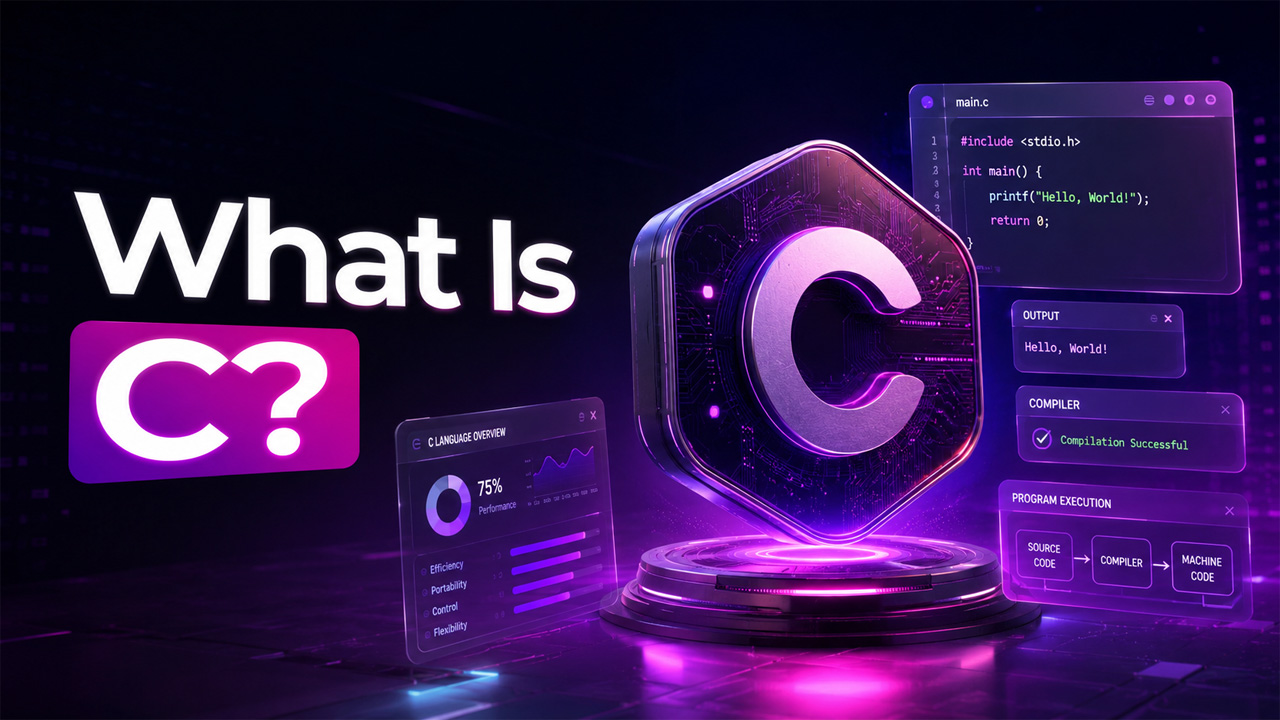
C can be defined as a procedural and general-purpose programming language utilized to build software that needs to run quickly and closely interact with computer hardware. It was built to provide programmers with direct control over system resources and memory while still being structured and readable.
In straightforward terms, C enables you to create programs by writing functions that are implemented in sequency, without the additional complexity of object-oriented concepts. Since it compiles down to efficient machine code, C is generally the language you choose for:
- Operating Systems (aspects of Linux, Windows, and macOS are written in C)
- Embedded systems for appliances, cars, and IoT devices.
- System utilities and database engines.
- Graphics-heavy applications and game engines.
- Core libraries that other coding languages rely on.
If you are new to the world of programming and exploring where to start, C is often recommended as a starting point since it teaches you regarding how computers actually process the instructions, instead of creating that complexity behind the abstractions.
History of C language: Where It All Began?
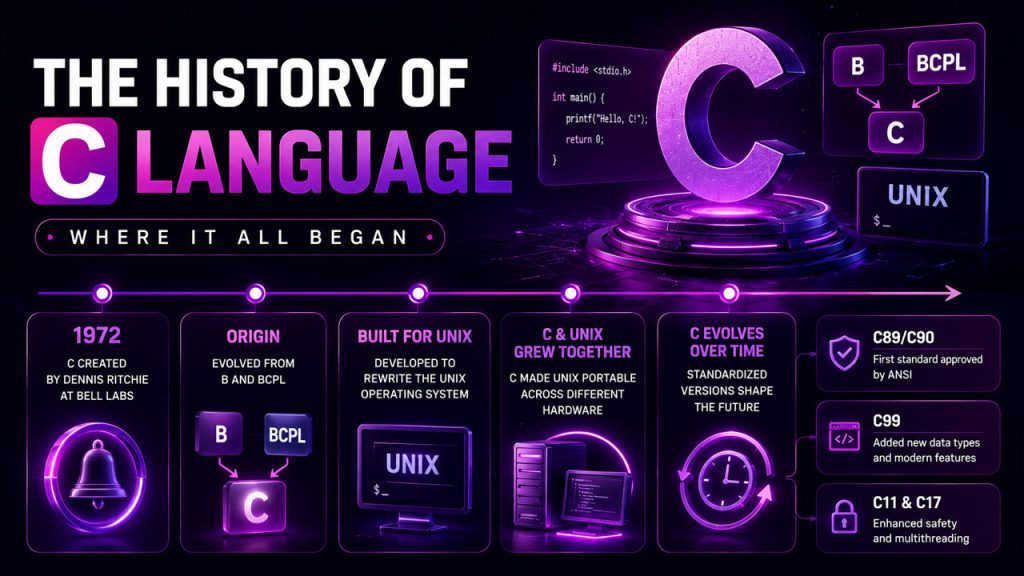
Dennis Ritchie built the C programming language at Bell Labs in 1972. It originated from two earlier languages, B and BCPL, and was developed originally to rewrite UNIX operating system, which had been written previously in assembly language.
Due to this close relationship, UNIX and C evolved side by side, and bulk of the portability of UNIX across distinct hardware platforms came from the fact that it was written in C instead of the assembly code specific to the machine.
Over the course of decades, the language has evolved through numerous standardized versions to ensure it remains consistent across platforms and compilers, including:
- C89/C90 — This was the first standardized version, approved by the American National Standard Institute.
- C99 — Introduced new types of data and enhanced support for modern programming requirements.
- C11 and C17 — Further improve the programming language with more effective safety features and multithreading.
Even though we have new languages entering the scene, the stability of C and its significance as the foundation for newer languages have retained its relevance across five decades of computing.
C Programming Basics: Main Features
Comprehending the basics of the C programming aids in explaining why the language has endured for so long. A few key characteristics differentiate it from the rest :
- Procedural Structure — Programs are structured around functions instead of objectives, making the logic simple to follow.
- Low-level Memory Access — C enables direct memory manipulation via pointers, providing developers with detailed controls over the storage and accessibility of data.
- Portability — Code written in C can be complied and executed on a broad range of operating systems and hardware with minimum changes.
- Small footprint — The language also entails a compact set of in-built functions and keywords, ensuring compiled programs remain lightweight.
- Support for Rich Library — Includes standard libraries such as stdlib.h, stdio.h, and string.h ensure ready-made functions for input/output, string handling, and memory management.
If you are just getting started and need a wider look at where to learn coding fundamentals such these, resources like Top Programming Tutorials can enable you to compare different learning paths before you commit to one.
Benefits of C Programming
The C programming benefits go a long way toward explaining why it is still being taught and used in industrial applications:
- Efficiency and Speed — C directly compiles machine code, resulting in quick execution with minimum overhead.
- Strong Foundation for Other Languages — Learning C makes it simpler to choose from programming languages such as C#, C++, and Java, since bulk of their syntax comes from C.
- Better Control Over Hardware — Developers can manually manage memory, which is vital for systems programming and applications critical for performance.
- Wide industry adoption — C is embedded in compilers, operating systems, and countless legacy platforms that businesses still depend on.
- Structural Simplicity — Without the additional complexity of objects and classes, beginners find it very easy to learn C language from scratch.
Having said that, C is not the only coding language created for system-level work or performance. We have newer alternatives in the market like the Rust Programming Language, which were built to address a few of the long-standing challenges of C, specifically around memory safety, which still targets similar applications such as embedded software and operating systems.
A Simple C Program Example
Curious to know how a CRM program is structured? Let us know that with the help of an example-
#include <stdio.h>

int main() {
    printf("Hello, World!");
    return 0;
}
In this short program, there is a standard header file (#include <stdio.h>) which contains the programs for standard input/output library, int main () { is the main function where the execution starts, and there is a printf statement (“Hello World”) which is to be printed as it is on the screen. Now, notice the return 0 statement. This means that an integer “0” value is returned to the main function that called it. By industry standard, return 0 means that the program was executed successfully.
No matter whether the C program is simple or advanced, it follows a similar pattern: include the libraries you require, define your functions, and execute the logic inside main().
Once a program like this is written, you should test it to make sure that it functions like it is intended for. If there are errors, you must identify and debug them. The basics of software testing remain the same irrespective of whether you are testing one program or hundreds. If you are interested in learning about how testing basically works and what is the difference between manual and automated testing, refer to our guide on Software Testing Basics.
Conclusion
So, what is C in the most straightforward terms? It is a portable, quick, and procedural language that has transformed the way modern software is programmed. From building operating systems to teaching new developers how hardware and software interaction works, C remains a vital skill in the toolkit of any programmer. Irrespective of whether you are developing embedded systems, exploring systems programming, or just want to learn how coding logic works, understanding C provides you with a great technical base that you can carry on when you learn modern programming languages