


 Share on media



A node in networking is any connection point or device within a network that can receive, send, or forward data. This involves printers, computers, switches, routers, servers, and even smartphones. In simple works, if a device links to a network or contributes to exchange of data, it qualifies as a network node.
Each node is often recognized by a unique address, like an IP address, which enables other devices on the network to find and communicate with it. In the absence of nodes, there would simply be no way for the data to go from one point to another. They are the basic building blocks that make networking quite possible.
What Are the Different Types of Nodes in a Network?
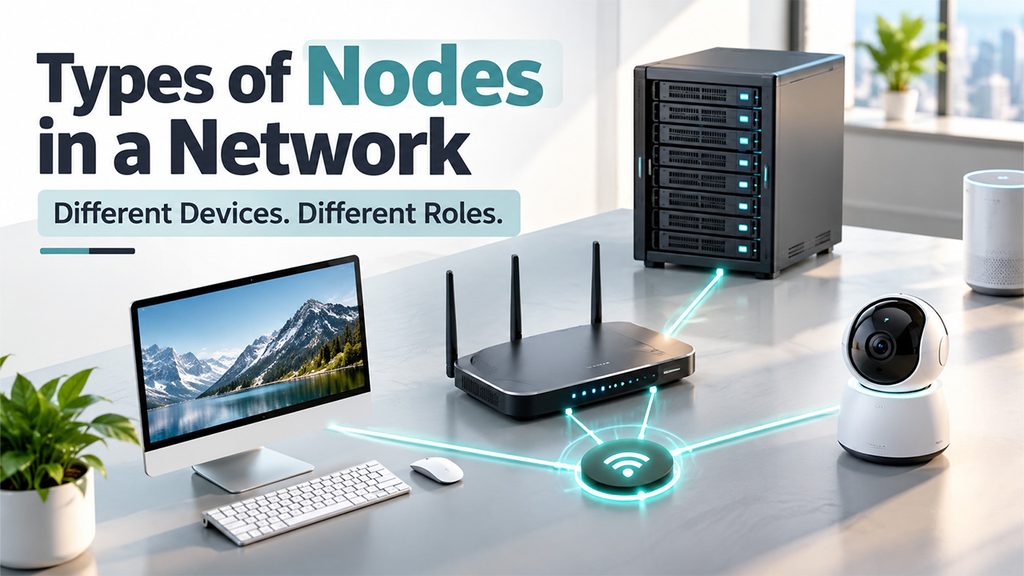
Not all nodes work in a similar way. As per their role, network nodes often falls into a few wide categories:
- End devices (endpoints): Smartphones, computers, and printers that consume or generate data. These are often the end points for data.
- Intermediate nodes: Switches, routers, and bridges that do not create or leverage data themselves but forward it to the right destination.
- Server nodes: Unified machines that provide resources and store data like applications, files, or hosting services to other nodes on the network.
- IoT nodes: Smart devices such as cameras, sensors, and connected home appliances that link over a network without being conventional computers.
Also Read: What is a Mesh Network? How It Works, Types, and Benefits
How Nodes Operate in a Network?
Each node performs a particular function depending on where it exists in the network. Here is how the process often unfolds:
- Data is segmented into smaller packets before transmission.
- Every packet is sent to the node, which is nearest, which can be a switch or a router.
- The node assesses the destination address of the packet and forwards it along the most efficient path.
- This goes on, from node to node, until the packet reaches its specified endpoint.
Protocols such as TCP/IP cover this complete exchange, making sure that packets are reliably transmitted and correctly reassembled at the destination. Nodes also manage:
- Data Transmission – Sending information over the network.
- Data Reception – Accepting incoming data for processing.
- Routing and Switching – directing traffic to the right destination.
- Resource Sharing – Enabling devices to share files, printers, or network connections.
Since server and domain configuration impacts how reliably a node communicates on the web directly, it is worthwhile to review our walkthrough on connecting a domain to a WordPress website if you are establishing a new website and need the underlying network path to correctly fix it from the first day itself.
Why Is Nodes Important for the Performance of Website?

For website owners, node behavior is not just a concept of abstract networking. It has a direct impact on uptime, speed, and user experience. When a visitor requests your page, the same requests pass through different nodes, including routers, servers, and content delivery points, before your website loads.
A few useful takeaways:
- More efficient routing of node means quicker page load times.
- A poorly configured or congested node can lead to bottlenecks that can slow down your entire website.
- Content distribution across numerous nodes geographically spread out, as a CDN does, minimizes the distance data needs to travel.
If speed of the website is a major concern, this comparison of WordPress CDN plugins explain how content distribution across a global nodes network can meaningfully minimize load times for visitors in distinct regions.
Conclusion
A node in networking is just any device which is capable of receiving, sending, or forwarding data across a network, whether that is a printer, computer, router, or server. Comprehending how such connection points aid in explaining everything from standard file sharing to the loading of your website for a visitor halfway across the world. Irrespective of whether you are fixing a slow connection or planning the infrastructure of your website, understanding the role of every network node in mind will make the core technology significantly unmysterious.
Frequently Asked Questions
Is a router be considered a node?
Yes. A router is an intermediate node that routes data between devices and typically does not originate or terminate the data itself.
What is the main difference between a host and node?
A host is a specific node type, often an endpoint such as a server or computer. All hosts are nodes. However, not all nodes can be considered as hosts such as switches and routers, for instance, switches and routers are nodes but not hosts.
Can a mobile phone be a network node?
Yes. Any device that links to a network and can receive, send, or forward data including a smartphone, counts as a single node.
How many numbers of nodes can a network have?
There’s no established limit. A small home network might have only a handful of nodes, while big enterprises or internet-scale networks can involve millions of interconnected nodes collaborating together.
Does each node require a unique IP address?
Most nodes are provided with a unique IP address so they can be recognized and reached by other devices. However, a few data link equipment, like specific wireless access points, may not have their own IP address and instead work as part of the connection of another node.