


 Share on media
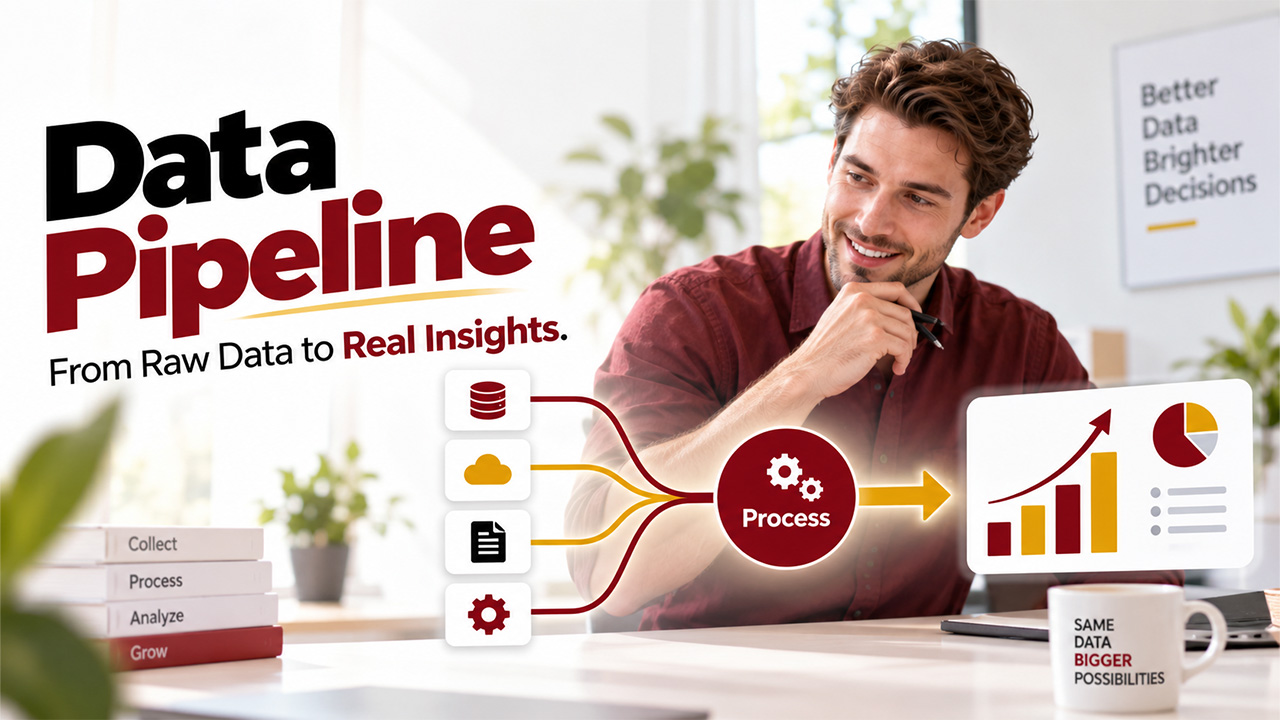


Every time you check a dashboard, get a personalized recommendation, or see real-time analytics update on a screen, there’s a good chance a data pipeline is quietly making that happen behind the scenes. It’s one of those foundational pieces of modern software that most people never see, yet almost everything data-driven depends on it.
By definition, a data pipeline is a series of processes responsible for transferring data from one place to another, preparing and organizing it to become useful in the process. The lack of a data pipeline makes the use of raw data impossible, as it remains disorganized and dispersed between multiple sources.
In this blog, we’ll break down what a data pipeline actually is, how it works, the different types you’ll come across, and why so many businesses rely on them daily.
What Is a Data Pipeline?
A data pipeline can be described as a series of processes that get data from its source, whether it be a database, application, sensors, or any other source, and then process it in such a manner that it finally ends up in a place of use, be it a data warehouse or any kind of analytical dashboard.
The process normally involves cleaning, formatting, or merging the data with other data sources so that it can finally be usable and not just a replica of what was in the source format.
It is similar to a pipeline system for the transportation of water, except that instead of transporting water from a reservoir to a tap, it transports information from multiple sources to a usable stream of data.
How a Data Pipeline Works
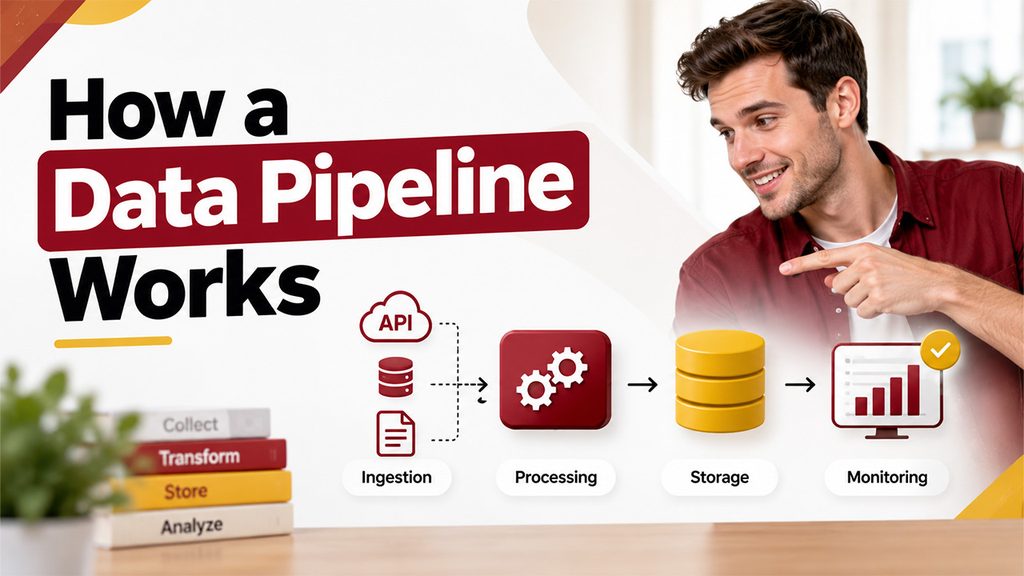
The vast majority of data pipelines work similarly, although the tools used might be different:
- Ingestion: It is retrieved from the source, either an API, a dataset, or an event stream.
- Processing: Raw data is cleaned, filtered, and turned into a consistent format that can be worked with.
- Storage: After processing, it is transferred to the final destination, such as a data warehouse or lake.
- Monitoring: Errors and failures in the process are detected, ensuring that no erroneous data goes unnoticed.
Much of the data ingestion process is done using API keys because API integration is a very popular approach to getting data from an external source into a data pipeline.
Types of Data Pipelines
Different types of data pipelines have unique ways in which they operate, and what makes them suitable is the rate at which data will be processed:
- Batch pipelines: Process the data in batches depending on schedules that could be hourly, daily, or even any other time. They are commonly used in cases where the analysis or reports do not need real-time analysis.
- Streaming pipelines: Handle data continuously as it’s generated, used for things like live dashboards, fraud detection, or real-time data integration where delays simply aren’t an option.
- ETL pipelines: These pipelines extract, transform, and then load data for processing.
- ELT pipelines: Extract and load first, then transform afterward, often used with modern cloud warehouses that can handle heavier processing loads on their own.
Choosing between these really comes down to how fresh the data needs to be versus how much processing power you’re willing to spend getting it there.
Benefits of Using a Data Pipeline
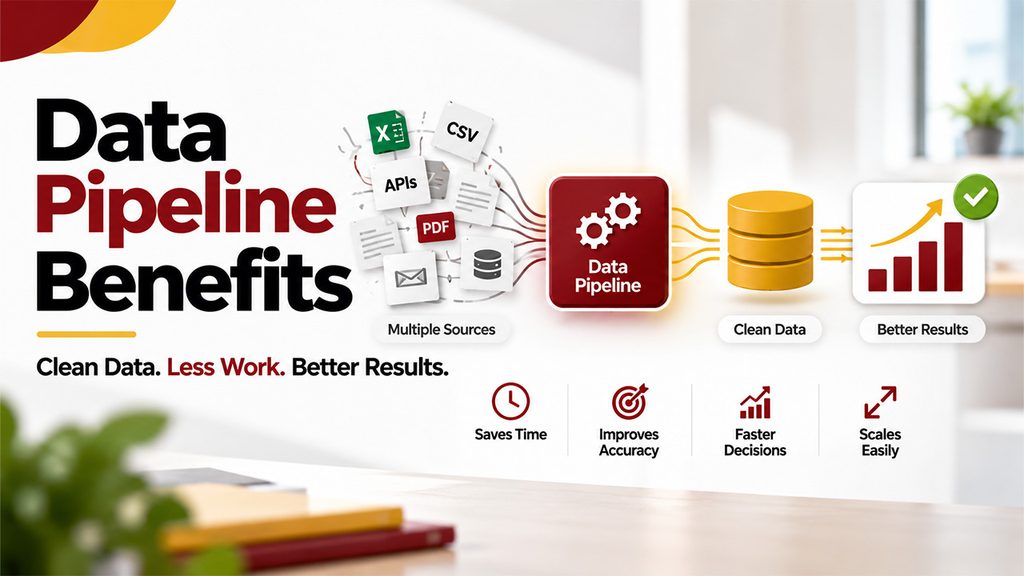
Once a data pipeline is properly set up, the payoff shows up in a few clear ways:
- Saves time: Automating data movement removes hours of manual collection and cleaning work.
- Improves accuracy: Consistent processing reduces the human error that comes with manual data handling.
- Enables faster decisions: Clean, organized data reaches decision-makers faster, especially with streaming pipelines.
- Scales easily: A well-built pipeline handles growing data volumes without needing a complete rebuild.
- Keeps data consistent: Standardized formatting means different teams aren’t working off mismatched versions of the same data.
None of this happens automatically, though; it takes a properly designed pipeline to actually deliver on these benefits.
Common Challenges
A good pipeline system is likely to face challenges, and some of those include:
- Data quality issues: Poor data quality from the source will make it difficult to process data in the later stages.
- Scaling problems: Pipeline systems meant to support small data sets may experience scaling challenges with increased use.
- Integration complexity: Integrating different data sources with varying APIs could be difficult.
- Monitoring gaps: Without proper alert mechanisms, it may take a long time before you discover any errors.
- Maintenance overhead: There will be a need for maintenance since requirements will continue to change.
None of these issues make pipelines a bad investment; they just mean planning for maintenance from the start rather than treating it as a one-time setup.
Conclusion
In the end, however, a data pipeline is how all of those disparate bits and pieces get turned into usable information. The process could take place once per night through a batch job, or it could happen instantaneously with real-time data; the point remains the same: to move data efficiently and without human interference getting in the way.
Putting it together will require some planning on your part, knowing the right kind of pipeline to put into place, watching out for quality problems, and making sure you have the proper monitoring in place, but the time savings and better decisions made will be worth it.
Frequently Asked Questions
What’s the difference between a data pipeline and ETL?
ETL is actually one specific type of data pipeline, focused on extracting, transforming, then loading data. A data pipeline is the broader term, covering ETL, ELT, streaming, and batch processes all under one umbrella concept.
Do small businesses need a data pipeline?
Not necessarily, but it depends on the amount of data. If you are manually transferring your data from one application to another rarely, then there is no need for it right now. When it becomes routine or starts causing mistakes, it will make sense.
Q. What’s the difference between batch and streaming pipelines?
Batch pipelines deal with data at set intervals of time, whether it be on an hourly or daily basis, whereas streaming deals with continuous data. Real-time requirements such as live dashboards can use streaming, and batch is good enough for reporting purposes.
Can a data pipeline fail silently?
Yes, as long as no monitoring mechanism is set up. Poor data and bad connections could get through without anyone noticing until they find out that there is an erroneous report.
What tools are commonly used to build data pipelines?
Commonly used tools are Apache Airflow, Fivetran, and Apache Kafka for streaming data. The selection of tools should be based on the volume of data, the requirement of real-time processing, and the amount of technical configuration required by the team.