


 Share on media



The guide explains the fundamentals of IPsec VPNs, along with their components, benefits, limitations, use cases, and how businesses can determine if the technology fits their network security strategy.
In the current digital landscape, businesses heavily rely on connected networks to support their remote employees, branch offices, cloud applications, and communication between different locations. With the operations of businesses moving online, protecting data as it travels across public and private networks has become an essential security requirement.
One of the technologies that meets such a requirement and has remained important for secure network communication is the IPsec VPN. The VPN creates an encrypted connection between devices, networks, or locations, allowing business data to travel securely over an untrusted network such as the public internet.
The technology is commonly used for connecting branch offices, enabling secure remote access, and protecting sensitive information transmitted between corporate networks.
What is an IPsec VPN?
An IPsec VPN, or Internet Protocol Security Virtual Private Network, is a type of secure network connection that helps protect data as it travels between two devices or networks over an untrusted network, such as the public internet. IPsec operates at the network layer, where IP addressing, routing, and packet delivery enable communication between devices across different networks.
IPsec uses a set of security protocols to encrypt data, authenticate communication devices, and maintain data integrity, creating a secure tunnel through which business information can travel without being easily accessed or altered by unauthorized parties.
Key Components of IPsec VPN
IPsec includes three main components, which include Authentication Header (AH), Encapsulating Security Payload (ESP), and Internet Key Exchange (IKE). These components make it easier to understand how an IPsec VPN protects network traffic.
- Authentication Header (AH)
The Authentication Header protocol, or AH, offers authentication and integrity protection for IP packets. The system helps verify that data has not been modified during transmission and can provide authentication of the source.
- Encapsulating Security Payload (ESP)
Encapsulating Security Payload, or ESP, is widely used in modern IPsec VPN deployments. The system can provide encryption, data integrity, authentication, and replay protection.
- Internet Key Exchange (IKE)
Internet Key Exchange, or IKE, is used to establish security associations and negotiate the parameters that are required for an IPsec connection. IKE helps VPN endpoints determine how they will communicate securely without requiring administrators to manually configure every cryptographic parameter for every session.
Types of IPsec VPN
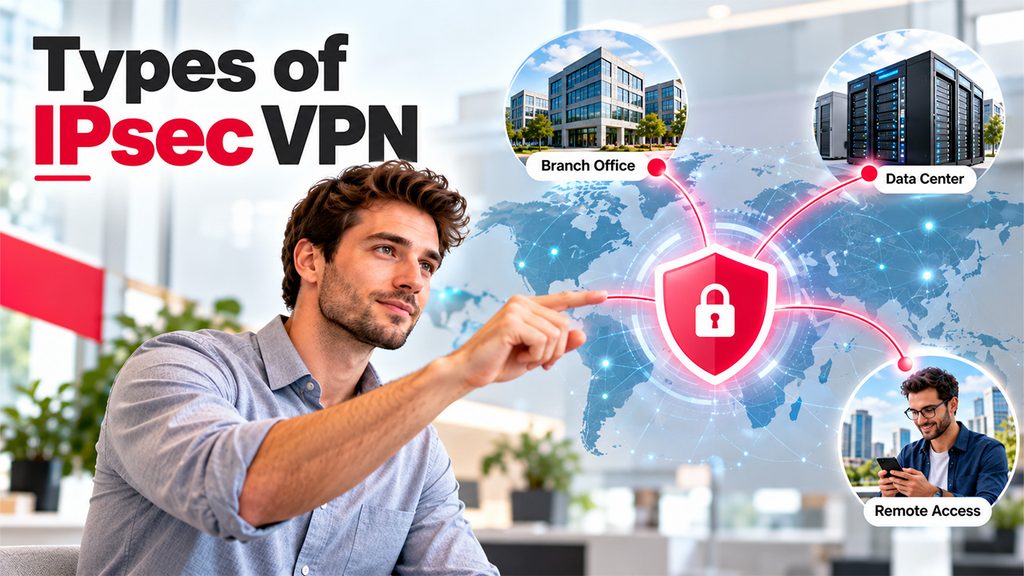
There are two major types of IPsec VPN, which include Site-to-Site IPsec VPN and Remote Access IPsec VPN.
- Site-to-Site IPsec VPN: The site-to-site IPsec VPN connects two or more networks through secure VPN tunnels. The system is used for branch office connectivity, data center connections, corporate network integration, connecting geographically distributed locations, and hybrid infrastructure.
- Remote Access IPsec VPN: The remote access VPN allows an individual device to establish a secure connection to the business network. Once authenticated and authorized, the employee may be able to access internal applications or resources according to company security policies.
Benefits of IPsec VPN
IPsec VPN offers key benefits to businesses as it provides an additional layer of protection while sharing files. Some of the key benefits of IPsec VPN are as follows:
- Strong Data Protection
IPsec VPN can encrypt data traveling between VPN endpoints, helping prevent unauthorized parties from reading sensitive information while it is being transmitted. This is especially essential when employees or offices communicate across public networks.
- Secure Network Connectivity
Through IPsec, businesses can connect to different networks securely without relying entirely on dedicated private network infrastructure. This makes it useful for organizations with multiple offices or distributed infrastructure.
- Protection on Untrusted Networks
IPsec allows organizations to establish protected tunnels across networks they do not control. This makes it useful for connecting remote offices and users without exposing business traffic directly to the public network.
- Data Integrity
IPsec VPN helps detect whether protected data has been modified during transmission. This is essential for maintaining confidence in the integrity of information moving between business systems.
IPsec Tunnel Mode vs. Transport Mode
IPsec uses two main modes to protect network traffic, which include Tunnel Mode and Transport Mode. The main difference between the two modes is how much of the IP packet is protected and how the packet is encapsulated.
IPsec Tunnel Mode
The Tunnel Mode of IPsec protects the entire original IP packet and encapsulates it inside a new IP packet. The original packet is encrypted, while a new IP header is added so the packet can be routed between VPN endpoints.
IPsec Transport Mode
The Transport Mode of IPsec protects the payload of the IP packet, while the original IP header remains largely intact. This mode is generally designed for host-to-host communication, where individual devices communicate directly with each other.
Key Difference
The key difference between IPsec Tunnel Mode and Transport Mode are listed below:
| Features | Tunnel Mode | Transport Mode |
| Protects | Entire original IP packet | IP packet payload |
| Original IP Header | Encapsulated or Protected | Remains in use |
| Common Use | Site-to-site VPNs | Host-to-host communication |
| New IP Header | Added | Generally, not added |
| Typical Endpoint | VPN gateways | Individual hosts |
How Does an IPsec VPN Work?
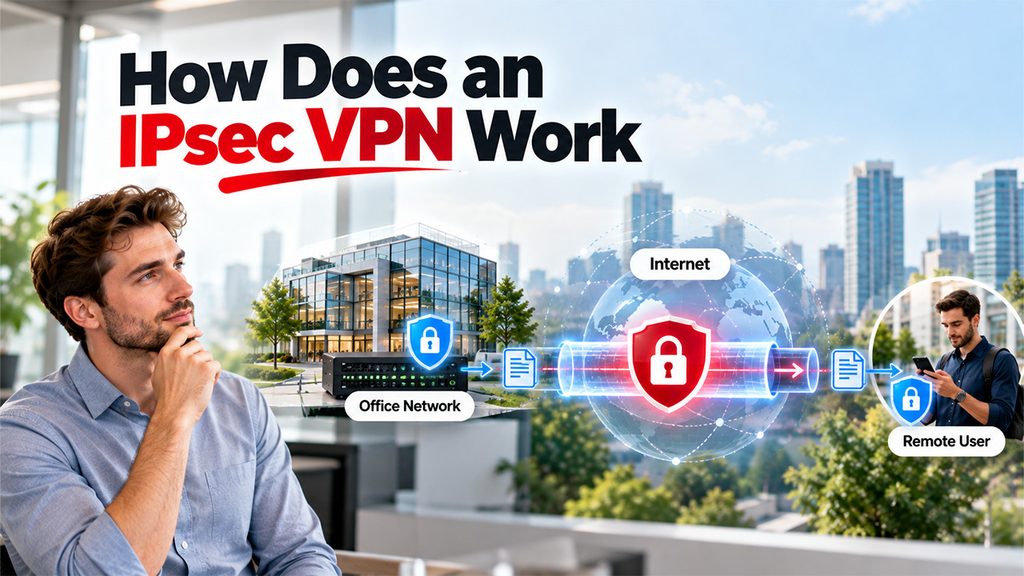
IPsec typically works by creating a secure tunnel between two endpoints. These endpoints could be VPN gateways located at different business offices, user devices, or other compatible network devices.
The process of IPsec involves the following steps:
- Authentication: The VPN endpoints verify each other’s identity.
- Security Negotiation: These endpoints agree on encryption and security settings.
- Key Exchange: Cryptographic keys are established for securing communication.
- Encryption: Data is encrypted before being transmitted through the VPN tunnel.
- Secure Transmission: The encrypted data travels across the network.
- Decryption: The receiving endpoint decrypts the data so it can be used by the intended system.
Common Business Use Cases
IPsec VPNs offer key benefits across all major industries, as they can support a variety of business scenarios. Some of the common use cases of IPsec VPN is as follows:
- Connecting Branch Offices: IPsec VPN help companies with multiple offices use site-to-site IPsec VPNs to securely connect their internal networks.
- Protecting Remote Access: With the protocol, organizations can offer remote employees secure connectivity to internal resources through compatible VPN infrastructure.
- Hybrid Infrastructure: Businesses operating a combination of on-premises infrastructure and cloud environments may utilize VPN technologies to create a secure connection.
- Secure Partner Connectivity: Businesses can establish VPN connections with trusted partners or external organizations when systems need to exchange information securely.
- Connecting Data Centers: IPsec can be used to create protected communications paths between geographically separated data centers or network environments.
Conclusion
IPsec VPN offers a secure way for businesses to transmit network traffic across untrusted networks. The system combines authentication, encryption, integrity protection, and secure key management, helping organizations protect communications between offices, remote users, data centers, and other network environments. For companies supporting distributed teams, choosing the Best Business VPN for Remote Teams also depends on factors such as secure remote access, scalability, performance, and ease of management. As businesses continue operating across offices, cloud environments, remote locations, and distributed infrastructure, IPsec VPN technology can provide an important layer of secure connectivity.
Frequently Asked Questions :
What is the difference between IPsec and VPN?
A VPN is a broader technology that can create a secure connection over an untrusted network, while IPsec VPN is a suite of protocols that can be used to build and secure a VPN connection.
What are the benefits of using an IPsec VPN for businesses?
IPsec VPN can help businesses protect data transmitted across public or other untrusted networks by offering encryption, authentication, and data integrity.
What are the limitations of IPsec VPNs?
One of the major limitations of IPsec VPN is that it might require careful configuration and ongoing management, especially in larger or more complex network environments. Misconfigured security policies, encryption settings, routing, or authentication can cause connectivity or security issues.
How can a business determine if an IPsec VPN is right for its network?
A business should evaluate its network architecture, connectivity requirements, security objectives, number of locations and users, and existing infrastructure.