




 Continue with Google

 Share on media


Introduction
operates well as a supplement for looking up references and practicing syntax. However, a structured degree or course still provides in-depth mentorship, deeper project work, and detailed feedback that a self-paced reference website is created to provide.
Researching online about a coding tutorial will make you land on the website W3Schools.com at some point. It is one of the most popular names in the domain of web development, well-known for segmenting technical concepts into short and digestible lessons instead of dense documentation. Irrespective of whether the objective is developing a first webpage, revising a programming language before a job interview, or just looking for a fast syntax reminder, the platform positioned itself as a reliable destination for programmers.
Regardless of whether you are a beginner or an experienced programmer, you will find resources on the platform that will help you out in your journey. In this blog, let us look at what the website offers really, how its tools operate, and a few points that are worth keeping in mind before committing to it.
What Is W3Schools.com?
W3Schools.com is a free e-learning platform offered for tech specialists and developers that ensures references, tutorials, and coding exercises for programming languages and web development. It has been functional since 1999 and is operated by Refsnes Data, which is a Norway-based company. Over time, the website has evolved from a small collection of CSS and HTML guides into a huge library encompassing a broad range of subjects, including:
- CSS and HTML for styling and structuring webpages.
- JavaScript for including interactivity to websites.
- Structured Query Language (SQL) and databases like MongoDB and MySQL.
- Programming languages such as Java, Python, C#, and C++.
- Libraries and frameworks like Angular, React, Bootstrap, and jQuery.
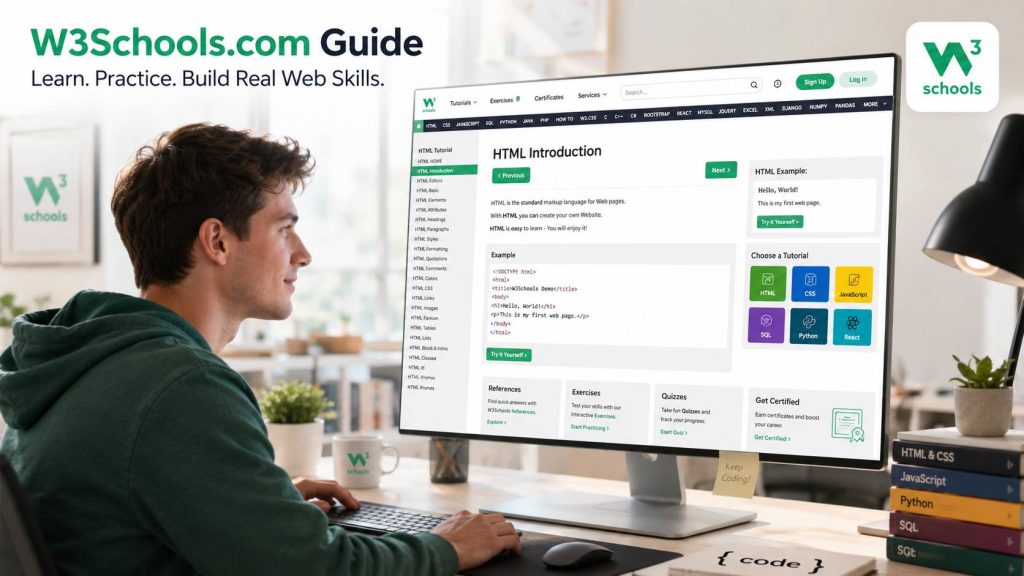
Every tutorial on the website is written in simple and beginner-friendly language and also has an interactive code editor, so learners can easily test their examples directly on the browser without downloading or installing any software. The platform also notes that the content is intentionally simplified to train users who are new to coding. The content is also consistently reviewed and updated. However, it does not claim to be error-free at all times, which is an honest and fair disclaimer for any vast reference library.
What Can You Learn on W3Schools.com?
The tutorials available on the platform are organized as per the subject, with every topic broken into short lessons that are stacked on one another. This is a step-by-step structure that makes it simpler for beginners to understand without feeling overwhelmed by the whole language at once. A few of the most searched categories on W3Schools.com are as follows:
- Web design basics, like CSS selectors, HTML tags, and responsive layouts.
- Programming and scripting, covering PHP, JavaScript, and Python fundamentals.
- Database management through NoSQL and SQL tutorials.
- Data structures and algorithms, a complex subject that makes new programmers feel confused and needs a comprehensive breakdown in simple language.
Apart from the lessons, the website also maintains an in-depth reference page for properties, tags, and functions, which working professionals use frequently as a fast lookup tool instead of a complete course. This dual purpose, part reference manual and part classroom, is one of the core reasons the resource sees consistent visits from the similar sets of users over months and years. A lot of the same fundamentals, like layout properties in CSS and box models, also directly apply to everyday website maintenance, which is why a supporting reference like breakdown of CSS padding can be a good companion as you navigate through the basics.
Main Features That Make W3Schools.com User-Convenient
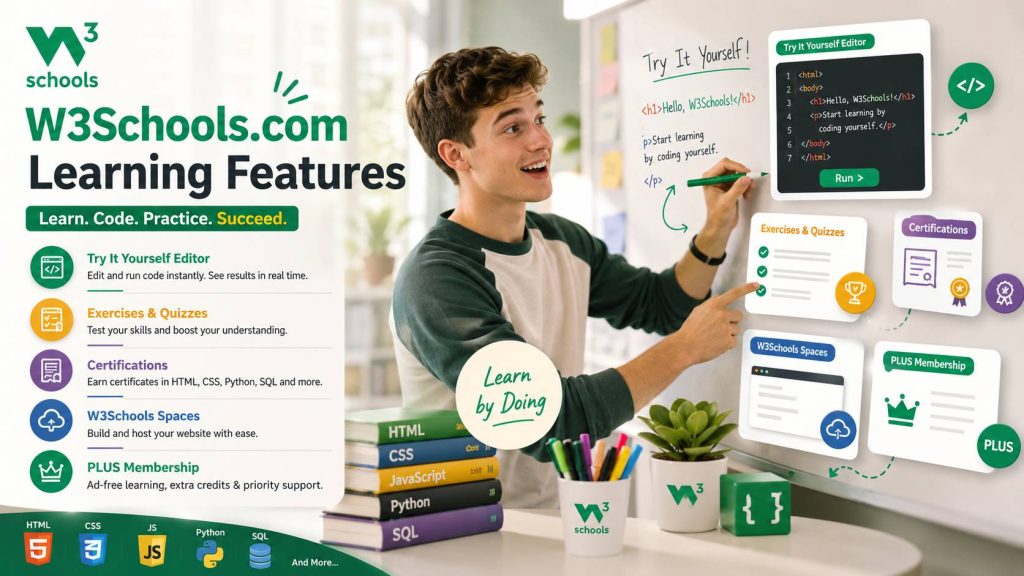
One of the main reasons that the platform is still maintaining a strong presence in the online e-learning space is due to its focus on hands-on learning instead of passive reason. A few features that stand out are as follows:
- Try It Yourself editor – Allows users to edit as well as directly run code on the pages and instantly see results.
- Exercises and Quizzes – Brief test after every topic to boost understanding of the concept you have just covered.
- Certifications – There are paid courses that end with a certificate for subjects such as CSS, HTML, Python, and SQL.
- W3Schools Spaces – an in-built tool for hosting a small website without an individual setup.
- PLUS membership – a paid plan that eliminates advertisements and includes additional learning credits and priority support for learners who use the website on a daily basis.
Such tools are particularly valuable for reasons who are also running their own websites and need to apply their learning instantly. For instance, someone who is making changes on raw website might find it useful to combine a lesson with a practical guide like how to edit WordPress HTML, where the similar tags which are taught on W3Schools.com can be applied on a real content management system.
W3Schools.com vs Similar Resources
Since the name is so extensively popular, a few unrelated or lookalike websites have appeared over the years, and it is useful to differentiate them before you choose a wrong one:
- W3Schools.in is a different website with an overlapping subject matter and a similar name. However, the structure of the website and copyright notice vary from the original, which indicates that it is not run by the same organization.
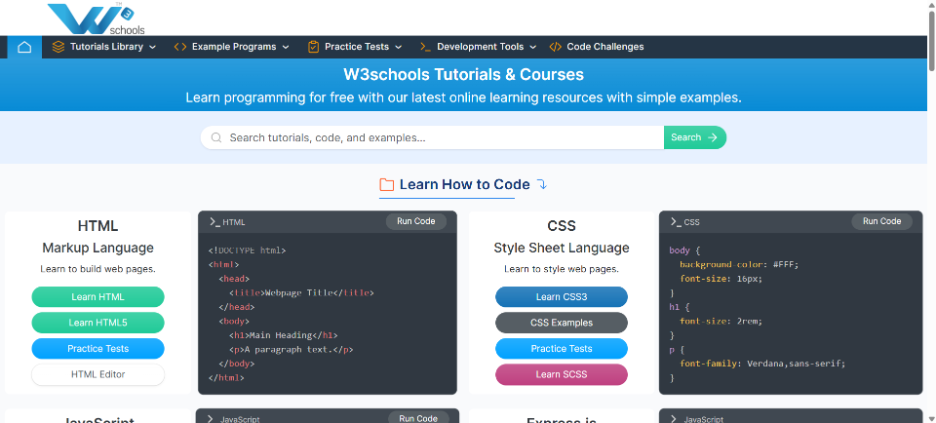
- There is a mobile application available on the Google Play Store under the name “w3 Schools.” It is created by a third-party developer instead of the official Refsnes Data team, carries advertisements, and has a limited number of reviews. Thus, it is worth going through the list before you install the software.
- Search engines sometimes reveal unrelated coding platforms in the same results, which is why it is important to confirm the domain of W3Schools.com before bookmarking any page to avoid confusion later, specifically for beginners who are still learning to understand the difference.
For readers who also handle a WordPress website along with learning to code, implementing on-page basics such as accurate metadata pairs and clean heading structures combines well with an individual resource on handling WordPress SEO without a plugin, since the core HTML concepts overlap closely with what you learn from the tutorials.
Conclusion
For anyone beginning their journey in web development, or just need a quick reference during coding, W3Schools.com turns out to be a widely used and practical resource. It is complete with an interactive editor, free tutorials, and organized lesson plans. Thus, you can learn coding skills at a manageable pace, without the pressure of sitting in a classroom. As it is true for any well-known digital resource, it aids to confirm that an app or a page is part of the official platform before trusting it, since similarly named products exist anywhere else online. When utilized correctly, it continues to be a great starting point for anyone developing practical and real coding skills.
Frequently Asked Questions :
Is W3Schools.com simple-to-use?
Yes, the core references, tutorials, and exercises are free. The PLUS membership and certificates are paid add-ons for the ones who need additional features.
Is there a need to sign up to utilize the website?
No account is needed to go through tutorials or leverage the code editor. However, signing in enables progress tracking across different sessions.
Is W3Schools.com recommendable for novices?
Yes, the lessons are created in plain and simple language and begin from the basics, which makes the website approachable for people with no prior background in coding at all.
Can W3Schools.com work in place of a formal degree or a coding course?
operates well as a supplement for looking up references and practicing syntax. However, a structured degree or course still provides in-depth mentorship, deeper project work, and detailed feedback that a self-paced reference website is created to provide.