


 Share on media



Client Access Server is a vital component within Microsoft Exchange Server ecosystems that works as the intermediary between mailbox server and end-users. It manages all connections to Exchange Server, including those from the Outlook Web App (OWA), Outlook, and mobile devices. The main role of the Client Access Server is to render proxying, authentication, and redirection services for client access requests, making sure that users can access their calendars, emails, and contacts smoothly.
Main Features of Client Access Server
- Authentication Services: CAS authenticates users before providing access to their mailboxes. It provides support to diverse authentication methods, including NTLM, Basic, and Kerberos ascertaining access to their services and email from distinct locations and devices.
- Client Connectivity: The Client Access Server handles all client communications, including MAPI over Outlook Anywhere, MAPI Over HTTP, ActiveSync, and web-driven connections through OWA. This makes sure that users can access their services and email from diverse devices, including NTLM, Basic, and Kerberos, ascertaining secure access to Exchange services.
- Proxying and Redirection: CAS works as a proxy for client requests, forwarding them to the relevant mailbox server. It can also redirect connections to a different CAS if required, ensuring high-availability and load balancing.
- Unified Messaging: The Client Access Server incorporates Unified Messaging (UM), enabling users to access UM services and voicemail directly from their email client.
- Availability of Services: CAS is purpose-built to ascertain high availability, with characteristics such as Load Balancing and Client Access Arrays to distribute client connections across diverse servers. Any impact on this availability can lead to substantial errors for end-users, including a 500 Internal Server Error, which generally signals an unexpected condition on the server that prevents it from completing the request.
How Client Access Server Operates?
In exchange server 2007, the Client Access Server role was introduced to take on a role quite like Exchange 2003 Front-End Server. The main function of the Client Access Server was to handle client connections for services like ActiveSync, Outlook Web Access, Outlook Anywhere, and other web-driven services. Apart from this, mailbox users in Exchange in 2007 are still directly connected to the Mailbox server for accessing public orders and mailboxes.
With the introduction of Exchange Server 2010, the Client Access Server was expanded to involve a new characteristic known as RPC Client Access Server. This service enabled Outlook to connect through MAPI/RPC directly to the Client Access Server, though public access server still needed a direct connection to the mailbox servers.
The RPC Client Access Service revealed in 2010 Exchange through numerous benefits to businesses:
- It allows mailbox connections to be directed through a centralized access path via the Client Access Server.
- Administrators could execute connection throttling and different rules to more effectively handle mobile connectivity.
- The user experience was greatly improved during mailbox moves and Mailbox server failovers.
- The RPC Client Access Server can be configured for higher availability, ascertaining accessibility to mailbox resources.
Comprehending What is Client Access Server and its evolution is vital for streamlining the reliability and performance of Microsoft Server Access ecosystems.
What Are the Main Functions and Functionalities of Client Access Server?
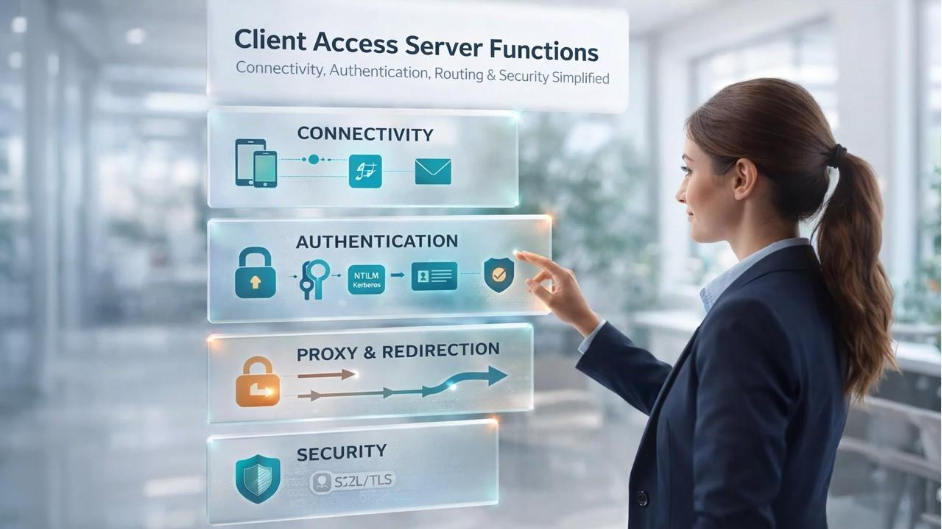
1. Client Connectivity:
Client Access Server provides support to a broad range of client devices and applications:
| Client Type | Protocol Used | Access Method |
| Outlook (External) | Outlook Anywhere (HTTP Over RPC) | Through CAS via the internet |
| Outlook (Internal) | MAPI Over RPC | Direct through internal network |
| Outlook Web Access (OWA) | HTTPS | Browser-driven access |
| Mobile Applications | Exchange ActiveSync | Secure access to mobile email |
| IMAP/POP Clients | IMAP4, POP3 Over SSL | Optional Protocols |
2. Authentication Services:
CAS implements diverse authentication methods to ascertain secure access:
- NTLM (Windows Integrated)
- Standard Authentication
- Kerberos Authentication
Such methods verify user credentials, ascertaining that only authorized users can gain access to mailbox databases.
3. Proxying and Redirection:
As per the mailbox server and client’s location, CAS either:
- Proxies the request to the relevant mailbox server.
- Redirects the client to a distinct CAS, specifically in scenarios that involve previous Exchange versions or client externals.
4. Network Security:
CAS works within the perimeter network, working as a shield between internal Exchange infrastructure and external clients. It leverages SSL/TLS encryption to ensure inbound connections, making sure that confidential data remains secure during the transit.
CAS Architecture and Components
Stateless Design
CAS is purpose-built to be stateless, meaning it does not have to retain session data. This design provides numerous benefits:
- Streamlined Load Balancing: No requirement for session affinity at the load balancer level.
- Scalability: Manages concurrent connections easily without any performance degradation.
- Flexibility: Any client access server in load-balancing array can manage any client request.
Connection Pooling
To streamline performance, CAS implements connection pooling, efficiently handling backend connections to Mailbox servers. This ascertains quick response times, even under higher loads.
Front-End Transport Service
CAS involves front-end transport service, known for:
- Apply mail-flow and anti-spam rules.
- Routing SMTP traffic between Exchange Transport Pipeline and Clients.
- Managing voice mail integrations and fax messages.
What Is the Role of Exchange CAS Server in Exchange 2013?
Exchange CAS plays a vital role in Exchange 2013. It takes client requests and directs them to the appropriate active mailbox database. The CAS server works like a front door and leverages diverse protocols to accept clients using mailboxes.
The Exchange CAS has diverse functionalities like:
- It provides support to Exchange ActiveSync while also delivering client authentication by sending authentication data to the relevant mailbox server.
- It handles client connections through redirection and proxy services.
- Exchange CAS makes the network secure.
- It redirects requests to a CAS which is better suited. This other Client Access Server might operate in a more recent Exchange Server version or even the one that might exist in a distinct location.
Conclusion
The Client Access Server is one of the pillars of Microsoft Exchange infrastructure, handling client connectivity, authentication, proxying, and security across all points of access. Ranging from its introduction in Exchange 2007 to its complete stateless architecture in Exchange 2013, CAS has evolved consistently to meet enterprise requirements. Its comprehensive support for load balancing, high availability, and distinct protocols makes it indispensable for dependable email processes. Effectively configuring and ensuring CAS ascertaining smooth mailbox access for users across all locations and devices.