

 Continue with Google

 Share on media

With today’s legal industry being competitive, having the right law firm website buildercan have significant implications for how many potential clients access your legal practice. Moreover, a strategically built website, while displaying your legal services, creates trust for your law firm, enhances your search engine rankings, and facilitates website conversions. Here is a guide on how to effectively build law firm websites.
Why a Strategic Website Is Non-Negotiable for Law Firms
In today’s digital-first legal landscape, your website is so much more than a digital brochure. It’s your firm’s most powerful marketing asset-and for most prospective clients, it’s the very first impression your practice makes.
The legal industry is highly competitive, and a basic, template-driven online presence just cannot establish you as having the level of credibility, compliance, and functionality necessary to meet client expectations. According to Law Firm Marketing Pros (2024), “96% of people seeking legal advice use a search engine to begin their search.” That one statistic means your online presence is the most significant factor in whether they call you, or the competition.
Here is what an effective law firm website must accomplish:
- Instant Credibility -A clean, fast, and intuitive site design can communicate instant credibility even before your visitors have read a single word.
- Inspire informed decisions —attorney profiles, practice area content, testimonials, and educational content encourage readers to qualify their needs with your firm, bringing them closer to becoming a client.
- Converts visitors into clients with integrated contact forms, live chat options, and strong calls-to-action.
Key industry statistics to keep in mind:
| Metric | Data Point |
| People who use search engines for legal advice | 96% |
| Law firms allocating most of their marketing budget online | 65% |
| Average annual spend on SEO marketing per law firm | $150,000 |
| Potential clients who search online first for an attorney | More than one-third |
| Law firms that consider content “very important” to their strategy | 89% |
| Law firms using social media to engage clients | 71% |
Why Most Legal Websites Fall Short
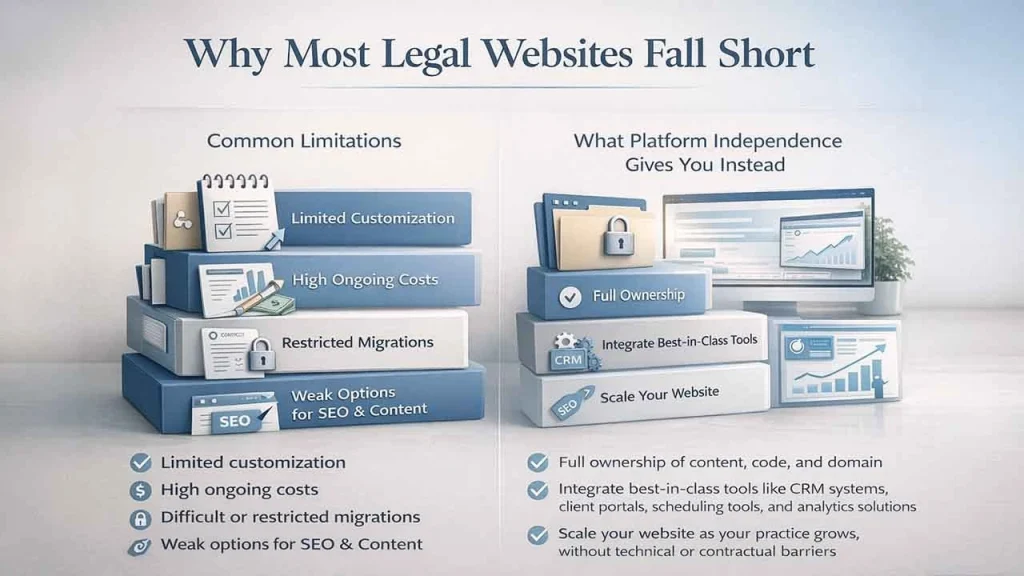
Some firms also end up disappointed due to investments in niche industry platforms that provide immediate solutions but little value in the long run. Knowing this is vital before choosing the best website builder for a law firm.
Common limitations of niche legal website builders include:
- Limited customization: You are often unable to fully control the layout, branding, or feature set of your site, which can leave your firm looking identical to dozens of other competitors.
- High ongoing costs: monthly platform fees can quickly eclipse the total cost of a custom-built solution in a couple of years.
- Difficult or contractually restricted migrations: want to leave their system? Getting your content and domain out can be complex, or even blocked by the terms of service.
- Weak options for SEO and content: Pre-set templates and generic one-size-fits-all content seldom rank well in competitive local search results.
What platform independence gives you instead:
- Full ownership of the content, code, and domain –you’re never locked in.
- The freedom to integrate best-in-class tools like CRM systems, client portals, scheduling tools, and analytics solutions.
- The ability to scale your website as your practice grows, without technical or contractual barriers.
Why WordPress Is the Smart Foundation to Build Law Firm Websites
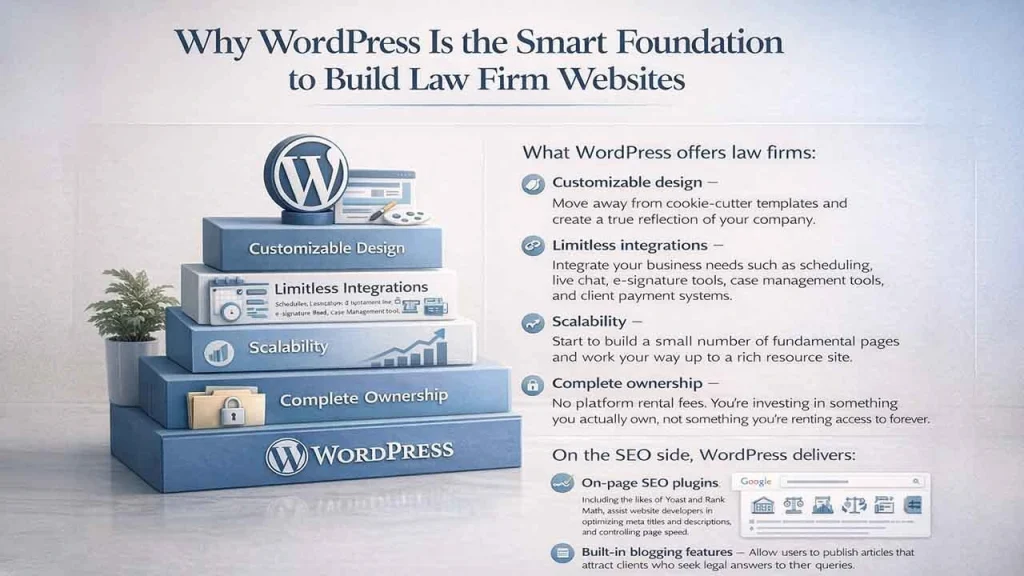
When it comes to designing a strong, flexible, and future-proof law firm website, WordPress stays ahead of the rest. This content management system is used by over 43% of all websites in the world (W3Techs).
What WordPress offers law firms:
- Customizable design-Move away from cookie-cutter templates and create a true reflection of your company.
- Limitless integrations –integrate your business needs such as scheduling, live chat, e-signature tools, case management tools, and client payment systems.
- Scalability –start to build a small number of fundamental pages and work your way up to a rich resource site.
- Complete ownership –no platform rental fees. You’re investing in something you actually own, not something you’re renting access to forever.
On the SEO side, WordPress delivers:
- On-page SEO plugins, including the likes of Yoast and Rank Math, assist website developers in optimizing meta titles and descriptions and controlling page speed.
- Built-in blogging features allow users to publish articles that attract clients who seek legal answers to their queries.
- The schema markup specific to legal services can increase the visibility on rich snippets in Google.
SEO Optimization: Getting Your Law Firm Found Online
For instance, numerous law firms embark on website development efforts that start off well, only to not achieve visibility as they have poorly implemented the part of the plan that dealt with SEO. For lawyers, this is not an option; organic SEO is vital.
Legal SEO falls into three core categories:
- Local SEO —optimizing for searches like “lawyer near me” or “estate planning attorney [city].”
- Practice Area SEO –Finding Clients Who Search Keywords Such as “Divorce Attorney” or “Personal Injury Lawyer.”
- Resource-Based SEO –writing helpful articles to answer frequently asked client questions and establishing yourself as an online authority over time.
Essential on-page SEO elements for law firms:
- Unique, keyword-rich content created for each individual practice area page
- Fast page load times, fully optimized for mobile — Google has adopted mobile-first indexing for all rankings.
- Authority building: Structure of internal and external linking
- An optimized Google Business Profile, as well as well-managed local citations from various directories
Content That Converts: Making Your Website a Legal Resource Hub
Beyond design, the best law firm websites serve as robust repositories of legal information. Through regular blogging, FAQs, and practice area articles, one delivers continued value to both your audience and your search rankings.
Why content matters for law firms:
- Regularly publishing quality content educates potential clients and demonstrates your expertise in your own voice.
- Targeted keywords and long-tail queries in blog articles attract clients who are actively searching for legal guidance.
- Firms that invest in content marketing stand out clearly from local competitors who neglect this approach.
High-performing content ideas for law firm websites:
- Frequently Asked Questions— answer the questions clients ask most often in your practice area (“How does the divorce process work in [state]?”).
- Case Studies and Success Stories—showcase your expertise and positive outcomes to build trust with prospective clients.
- Step-by-Step Self-Help Guides— offer practical, accessible advice for common legal problems your target audience faces.
Integrations and Custom Features: Standing Out from the Competition
A generic website leaves your company invisible in a crowded digital space. Thoughtful integration and customization turn your website into an actual business tool, catered to your day-to-day operations.
Essential integrations for legal websites:
- CRM and Case Management— connect with systems that manage leads, client intake, and service workflows without manual data entry.
- Online Scheduling— allow clients to book consultations directly from your website, eliminating administrative back-and-forth.
- Secure Contact and Payment Forms— build client trust through encryption and privacy-focused features that meet legal compliance standards.
Custom features that drive measurable results:
- Attorney bios and team profiles that humanize your brand and highlight individual expertise
- Clear, dedicated practice area pages so visitors can immediately identify your firm’s specializations
- Live chat or AI-assisted help desk features for immediate client engagement outside business hours
- ADA accessibility features, including screen-reader support, to meet legal compliance requirements
Just like organizations in other industries, doing well with purpose-built platforms — for instance, nonprofits and faith communities benefit from options in Best Church Website Builders—law firms see the greatest success when their website is purpose-built for the industry’s unique operational and compliance needs.
Key Elements Every Law Firm Website Must Include
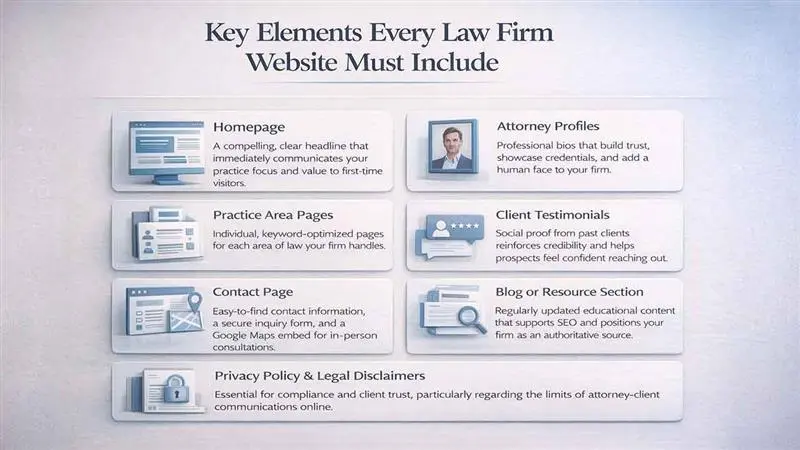
Regardless of the platform chosen, any high-performing law firm website needs these core components:
- Homepage— a compelling, clear headline that immediately communicates your practice focus and value to first-time visitors.
- Practice Area Pages— individual, keyword-optimized pages for each area of law your firm handles.
- Attorney Profiles— professional bios that build trust, showcase credentials, and add a human face to your firm.
- Client Testimonials— social proof from past clients reinforces credibility and helps prospects feel confident reaching out.
- Contact Page— easy-to-find contact information, a secure inquiry form, and a Google Maps embed for in-person consultations.
- Blog or Resource Section— regularly updated educational content that supports SEO and positions your firm as an authoritative source.
- Privacy Policy and Legal Disclaimers— essential for compliance and client trust, particularly regarding the limits of attorney-client communications online.
Conclusion
Building a successful law firm website builder is not just a simple case of choosing a template and adding a few pages, but rather calls for a very strategic approach to the task, including considerations for independence, optimization, content, security, and legal advertising guidelines.
When you build law firm websiteson a flexible, open platform like WordPress-and pair it with smart SEO, purposeful content, and features designed for legal practice-your website becomes a genuine business asset. It doesn’t just inform visitors; it builds trust, demonstrates expertise, and moves prospective clients confidently toward contacting your firm.
Selection of the best website builders for law firms involves making a choice between convenience and the need for adaptability and measurable results over time. Your next law firm client is online now – make sure you are ready to serve them by having a great law firm website.
FAQs
What is a law firm website builder?
A law firm website builder is a platform used to create and manage websites for legal practices. It ranges from niche legal platforms to fully customizable solutions like WordPress.
Why should my law firm use a custom website instead of a niche legal platform?
Custom websites give full control over design, SEO, and integrations while ensuring true ownership. Niche platforms limit flexibility, charge higher long-term fees, and complicate migration.
What is the best website builder for a law firm?
WordPress is usually said to be the best choice for growing firms due to its flexible, scalable nature, and strong SEO capabilities. It gives full ownership, unlike the proprietary legal platforms.
How important is SEO for a law firm website?
SEO is important because most of your clients are searching online for legal services. Good local and practice area optimization helps drive consistent, qualified traffic.
What ongoing content should my law firm publish?
Publish FAQs, legal updates, case studies, and practical guides on topics relevant to your audience. Regularly updated content establishes expertise and ensures high search engine rankings.
Does my law firm website need to be mobile-friendly?
Yes, it is necessary because Google will use the so-called mobile-first indexing. The speed and responsive design of a site raise rankings and client conversions.
What integrations should a law firm website include?
Basic integration with online schedules, secure online intake forms, as well as online CRM systems. Advanced integrations include online payments and online portals.
%201.png)

%201.png)

%201.png)