
 Continue with Google

 Share on media
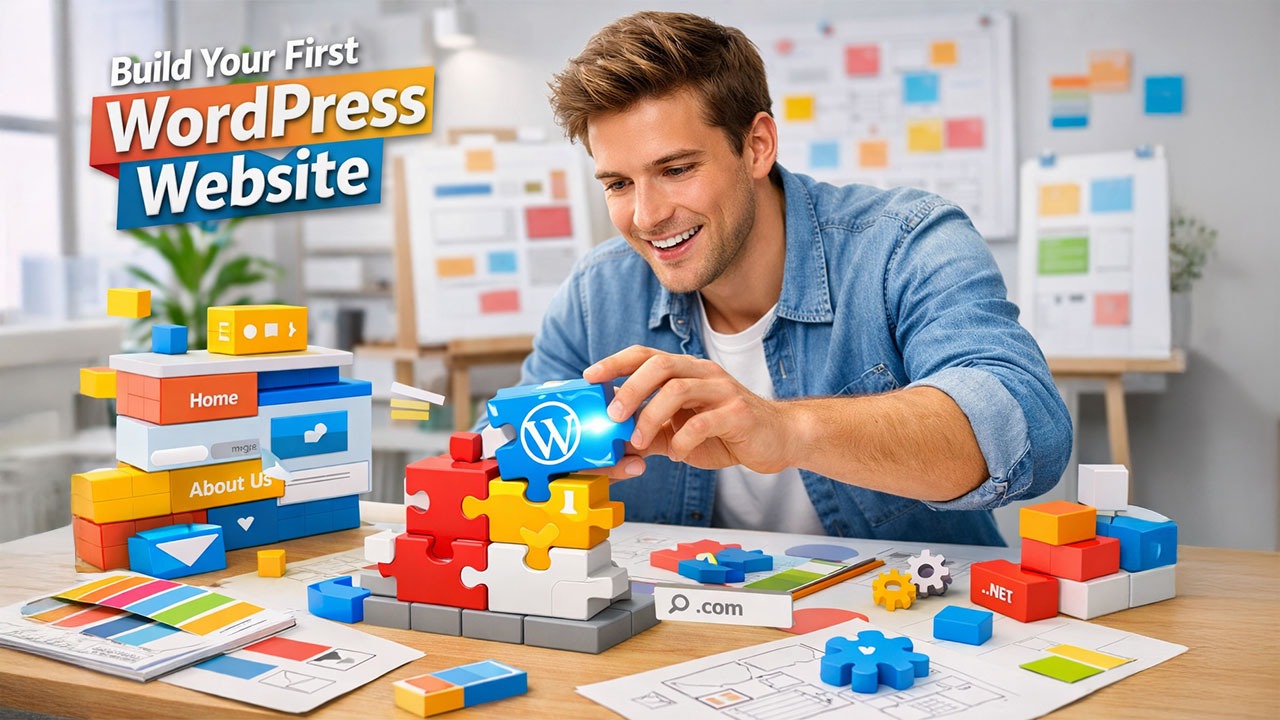
Currently, WordPress runs more than 40% of all websites found on the internet. If you are looking to build a blog, a business website, or an e-commerce site, one of the most valuable skills you can develop in life without the need for coding at all is how to make a WordPress website.
Its simplicity, flexibility, and extensive ecosystem of tools make it a platform of choice for beginners as well as professionals. In this tutorial, we’ll take you through everything from setting up a hosting account to creating your first page.
What is WordPress?
WordPress is a free and open-source Content Management System (CMS) that helps users develop, design, and display web content in an optimized way. WordPress is popular due to its flexibility and ease of use. It supports various types of websites. Some of them include:
- Blogs and personal portfolios
- Business websites
- E-commerce stores
- News and media sites
At its core, WordPress is an interface that allows users to design, customize, and publish content on the internet without the need for any programming skills.
In order to use WordPress to design an effective website, it is important to be familiar with two main parts of the WordPress dashboard:
- Dashboard – The very first screen that is displayed after a WordPress site is logged into. Everything in WordPress is controlled from this main screen.
- Admin Screens – The various parts of the left-hand pane of the WordPress site, such as Posts, Pages, Appearance, Plugins, and Toolbar, through which you can modify your site.
WordPress.com vs WordPress.org: Which One to Choose?
Before you create a WordPress website, it is important to understand the difference between the two available platforms:
| WordPress.com (Hosted Service) | WordPress.org (Self-Hosted) |
| Free to launch; paid plans required for advanced features | Free software; requires paid hosting and domain annually |
| Beginner-friendly; minimal technical knowledge required | Requires self-management of customisation, maintenance, and configuration |
| Built-in hosting; security backups available with upgrade | Requires an external host to handle site maintenance |
| Variety of themes available; custom themes accessible on upgrade | Can build own themes or use available custom themes for free |
| Plugins available on upgraded plans; self-managed | Wide range of custom plugins available; may have compatibility issues |
For beginners, WordPress.com is the more accessible and straightforward starting point, as it handles hosting and technical maintenance automatically.
Step-by-Step: How to Make a WordPress Website
Step 1: Choose a Hosting Platform
A hosting platform is where your website lives on the internet. Several hosting platforms are specifically designed for WordPress websites, including:
- Bluehost
- GoDaddy
- HostGator
- DreamHost
- Kinsta
- A2 Hosting
WordPress recommends Bluehost and DreamHost for hosting an externally hosted domain. These websites offer various plans. It would be great if you could compare these plans according to the size of your websites.
WordPress offers a facility through which we can launch a website for free. However, we need a paid plan to use advanced features.
Step 2: Select a Domain Name
Your domain name is the address of your website on the internet. It is how users can locate your website. Some points that need to be considered while selecting a domain name are as follows:
- It should be correct and easy to recall
- It should be related to your website
- It should be a Top Level Domain, i.e., it should end with .com, .org, .co, or .in
For instance, in www.outrightsystems.org, “outrightsystems” is the domain name, and “.org” is the TLD. A good domain name will also assist you in creating your brand identity online and will increase your search results.
Once the domain name is chosen, it can be registered through the Purchase Domain option in the Domains option of Bluehost.
Step 3: Install WordPress
After the hosting and domain are set up, the next step is to install WordPress and create a website:
- Go to the section called My Sites in the left panel of the main screen of Bluehost
- Click Add Site
- Select Create New Site or Migrate Existing Site, depending on whether you are transferring a website
For a beginner, it is advisable that during the installation, the option for Best WordPress for Beginners is selected. After installation, it is advisable that you log in using your authenticated information.
Note: WordPress gives the opportunity for the creation of several sites using a single installation.
Step 4: Choose and Customise a Theme
WordPress provides users with a wide variety of free and paid themes. However, it is important to note that all the themes provided by WordPress are developed by professional developers. WordPress themes are used for the design of the website. Further, the themes can be changed anytime using the admin dashboard.
To install a new theme:
- Go to Appearance → Themes
- Click Add New Theme
- Browse available options, preview your preferred theme, and click Install
- Once installed, click Activate
To customise the active theme:
- Go to Appearance → Customize
- Edit individual sections of the website as required
- Click Save, then Publish to make your changes live
You can also use the Editor option within the Appearance section to make more detailed visual changes to your site layout.
To change to a different theme:
- Go to Appearance → Themes
- Select the theme you want to use
- Click Activate
Step 5: CreaAte Posts and Pages
WordPress separates website content into two distinct categories:
- Posts — Used specifically for blog content and time-sensitive updates
- Pages — Used for static content such as About, Contact, Services, or Home pages
To create a blog post:
- Go to Posts → Add New
- Write and format your content using the editor
- Use Save Draft to save your work, or click Publish to make it visible on the website
To create a static page:
- Go to Pages → Add New
- Add your content and configure desired settings on the right panel
- Click Publish when the page is ready to go live
Additional Customisations Available in WordPress
Once the basic website structure is in place, WordPress offers several powerful tools for further customisation and functionality. Anyone learning how to make a WordPress website should be familiar with these options before launching their site.
1. Elementor — Drag-and-Drop Page Builder
Elementor is among the most popular plugins for users of WordPress. Elementor is a drag-and-drop editor with a visual builder, and it is very simple to edit and design any page on a website without having to learn HTML and CSS. Elementor has a variety of content widgets, and users can create a full page with them.
To install Elementor:
- Go to Plugins → Add New
- Search for Elementor in the search bar
- Click Install, then Activate it from the Plugins section
To use Elementor:
- Go to any post or page and click Edit with Elementor
- Use the visual builder to customise layouts, add widgets, and design the page
Using a WordPress Website Builder like Elementor is particularly useful for those who want professional-looking pages without writing a single line of code.
2. WordPress Plugins
Plugins are add-ons that extend the functionality of a WordPress website. There is a wide variety of both free and paid plugins available through the WordPress dashboard and third-party sources.
To install a plugin:
- Go to Plugins → Add New
- Search for the required plugin
- Click Install, then Activate
Some essential plugins for a WordPress website include:
- All in One SEO — Assists in driving organic traffic from Google and other search engines
- WP Simple Pay — Enables credit card payments directly from WordPress
- Smash Balloon — Enables widgets to show social media feeds
- MonsterInsights — Connects your site to Google Analytics to track your site’s performance and visitor insights
3. Payment Methods via WooCommerce
For online shops that offer products and services for sale online, it is important to set up a payment gateway. WooCommerce is a popular plugin that allows users to set up an online shop within WordPress. It provides great customisation and has many features.
To install WooCommerce:
- Go to Plugins → Add New
- Search for WooCommerce, click Install, and then Activate
- Complete the setup wizard to configure payment options and store details as per your requirements
4. Additional CSS
For users with knowledge of CSS (Cascading Style Sheets), WordPress allows custom styling to be applied directly through the dashboard:
- Go to Appearance → Customize
- Click on Additional CSS in the left panel
- Write or edit your CSS code in the provided space
- Click Publish to save and apply the changes
5. Paid Themes and Templates
While free themes are available for running blogs, for running responsive and feature-rich websites, access to paid templates is available within WordPress itself. These include access to:
- Additional plugins and extended functionality
- Better page builder tools and design options
- Pro demo and design layouts
- Advanced configuration settings
Core Components of a WordPress Website
Understanding how WordPress is structured internally helps with better management and troubleshooting:
- WordPress Core — Runs all basic functionality, manages content, and handles interaction between the database and authentication system
- Extra Files — Additional files that can be added conveniently through the WordPress Dashboard
- Database — WordPress uses MySQL to store all website files and data
- Admin Screen — The central control area for managing and configuring all website tasks
Benefits of Using WordPress
WordPress offers several distinct advantages over other website-building platforms such as Wix, Shopify, and Weebly:
- Capable of handling both small and large websites with equal efficiency
- No technical background required to get started
- Plugins and themes offer extensive flexibility and customisation
- Highly scalable and robust for growing websites and increasing traffic
- Trusted and used by major global brands including IBM Jobs, Microsoft News, BBC America, and Flickr
Conclusion
WordPress is a reliable, scalable, and powerful platform for anyone looking to develop a website, whether it is a personal website, a small business website, or a large-scale corporate website. Whether you are a complete beginner or someone with some technical experience, the steps covered in this guide make it straightforward to create a WordPress website from scratch without writing a single line of code. It is the go-to platform for millions of website owners across the globe due to its ease of use, availability of a vast array of themes, rich plugin library, and customisation possibilities.
Understanding how to make a WordPress website from scratch — from choosing a hosting platform and domain name to installing themes, creating content, and extending functionality through plugins — is entirely achievable without any programming expertise whatsoever. The platform is continually updated with new features, making it a reliable solution for creating websites now and into the future.
%201.png)

%201.png)

%201.png)