

 Share on media



Most people are still doing SEO like it’s 2020. They write a blog, stuff a few keywords, and pray. That doesn’t work anymore.
Now, you need advanced local SEO services and SEO audit services with better technical foundations, data-led content, deeper user intent mapping, and local trust-building signals. In this blog, we will explain 10 advanced SEO techniques that can boost your rankings.
1. Start With a Deep Technical SEO Audit
Before you write a single word of content, you need to fix the foundation. So, start with a technical SEO audit that checks:
- indexation issues
- redirect chains and broken links
- duplicate content
- XML sitemap and robots.txt
- mobile usability
- Core Web Vitals
- HTTPS and security
- schema implementation
2. Hyper-Local Micro-Area Pages
Broad city pages are no longer enough. Search is moving toward hyper-local intent.
You must create micro-area landing pages to show up for these searches. These pages should include:
- neighborhood names
- landmarks
- directions
- locally focused FAQs
- local reviews
3. Semantic Content Clustering
Search engines now look for Topical Authority. They want to know if you are an expert on the entire subject.
That’s where you need content clustering. It is the process of grouping related content around one main pillar page. This structure helps search engines see your site as an authority rather than a random collection of articles. It improves internal linking and user navigation to a great extent.
4. Entity-First Content Strategy
Search engines now have the ability to understand entities, such as a brand, person, location, etc. To use an entity-first strategy:
- define the key entity (your brand, service, city, etc.)
- create strong “about” and service pages
- maintain consistent NAP (name, address, phone) data
- get mentioned in reputable directories and websites
When search engines clearly understand who you are, ranking becomes much easier.
5. Optimize for Voice and Conversational Search
Nowadays, more searches are spoken than typed. But the catch over here is that we don’t speak the way we type.
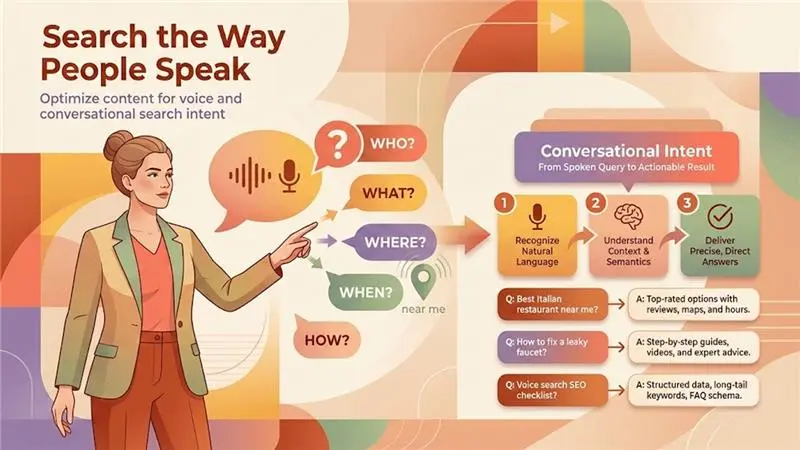
To capture this, you need to target Natural Language Queries. Here’s how to do it:
- write in a conversational tone
- use FAQ sections
- target “who, what, where, when, how” queries
- include “near me” intent
6. Revive Old Pages
Do you have 500 pages, but only 50 get traffic? Those other 450 are actually dragging your site down. Remember, Google judges your site based on the average quality of all pages.
So, always keep an eye on analytics and note down pages with zero traffic since many months. You have two choices to fix it:
- Update it with fresh info
- Delete and merge it with a fresh blog
7. Upgrade Website Experience and Core Web Vitals
Speed is money. Specifically, Google now cares about INP (Interaction to Next Paint). This measures responsiveness. When a user clicks Menu, does it open instantly, or is there a tiny lag? That lag kills conversions.
You can find out such issues that affect your rankings through SEO audit services. Check out how to fix such technical errors:
- Compress your images
- Minify your JavaScript
- Remove unused CSS
- Reduce third-party scripts
8. Optimize for Zero-Click Searches
Sometimes, the user doesn’t even click. They see the answer right on Google’s result page.
Unfortunately, you don’t have the option to fight this. But you can capture the overview space by:
- targeting featured snippets
- answering questions concisely
- providing definitions and summaries
9. Use Structured Data and Rich Snippets
Structured Data (JSON-LD) is code you add to your site that highlights specific info like:
- Star Ratings (Reviews)
- Event Dates
- Product Prices
It makes your search result look different. A result with 5 yellow stars gets a 30% higher click-through rate than a plain text result.
10. Internal Linking with Descriptive Anchor Text
Internal links guide both users and search engines through your site. So, write good anchor texts with:
- Description
- Natural keywords
- Topic hierarchy
Strong internal linking also spreads authority to important pages like service pages and location pages.
FAQs
1.How long does it take to see SEO results?
It usually takes about 3 to 6 months. However, technical fixes (like updating old pages) can show results in a few weeks.
2.Is voice search really that important?
Yes. As homes get smarter, more searches happen away from screens, and SERP insights show that if you aren’t optimized for questions, you are invisible to Alexa and Siri.
3.Do I really need to delete old content?
Not necessarily! You have two smart choices. First, you can update it with fresh info to bring it back to life. Second, if the content is too thin, you can merge it into a relevant, stronger post and redirect the old URL.
Conclusion
SEO in 2026 is all about serving a human with technical precision.
You need a site that is fast, structured, and hyper-relevant to what your users are actually asking. If you are confused by terms like Schema, INP, and Snippets, don’t worry. You don’t have to do it alone!
At Growth Vive, we have the expertise to fix it with our specialized SEO audit services and local SEO services tailored to your specific location. Get in touch with us now!