




 Continue with Google

 Share on media
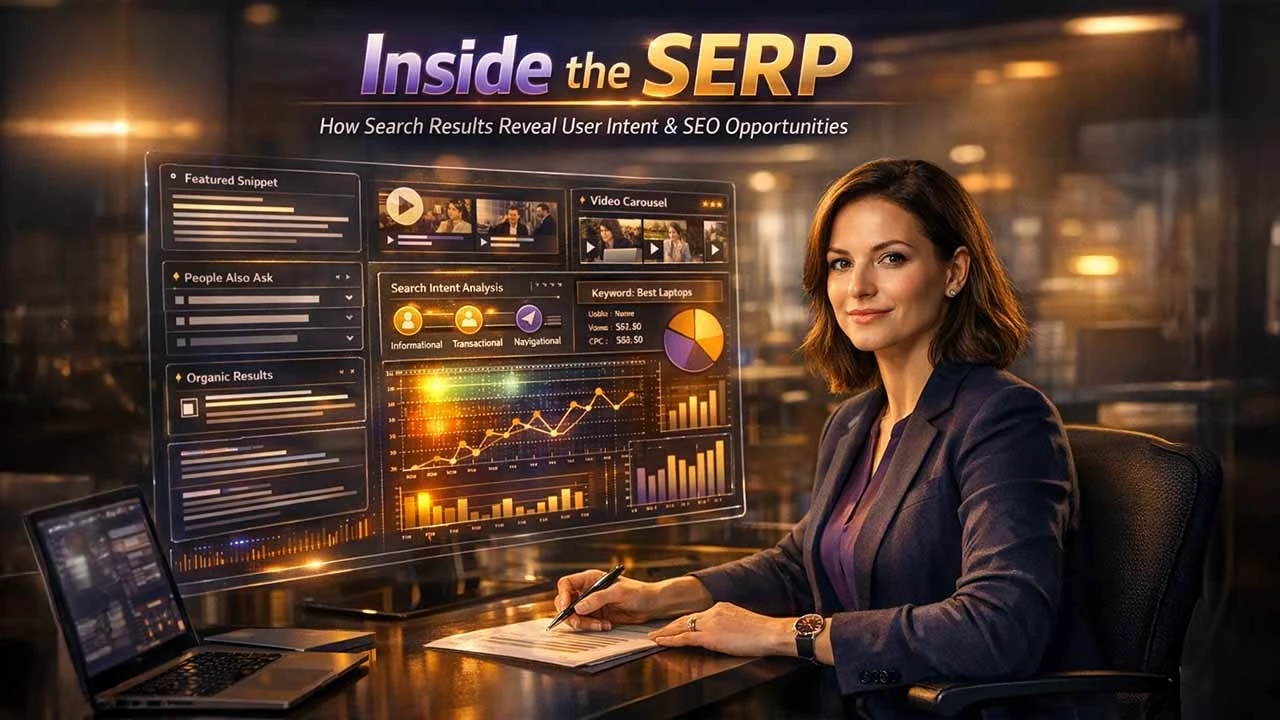


Every time you type something into Google and hit search, you are doing more than looking for an answer. You are revealing intent, and Google has been paying close attention to that intent for years. SERP insight goes beyond rankings. They help you read signals that Google has been collecting for years. These signals are built from what millions of people searched, clicked, ignored, and returned to.
Every featured snippet, every video carousel, every “People Also Ask” box exists for a specific reason rooted in user behavior. SERP insight helps you understand why those elements appear, which content formats Google favors for certain queries, and what are the gaps in your current strategy. Most content creators focus on optimizing the content itself, but SERP insight shifts that focus toward understanding the context around it.
If you have ever published a well-researched article that received little to no traction, the answer likely lies in what the SERP was telling you all along. This blog breaks down how to read those signals and use them to build smarter, intent-driven content strategies.
What Are SERP Insights?
SERP insights are observations and learnings drawn from analyzing search engine results pages (SERPs) for a given query. SERP analysis allows you to extract meaningful patterns from what appears on the results page, while SERP data provides the raw information needed to make informed decisions.
Instead of asking:
- “What keyword should I target?”
SERP insights ask:
- “What type of content does Google reward here?”
- “What format satisfies search intent?”
- “What problems are users actually trying to solve?”
It’s the difference between chasing keywords and understanding search behavior.
Why SERP Insights Matter More Than Keywords Alone
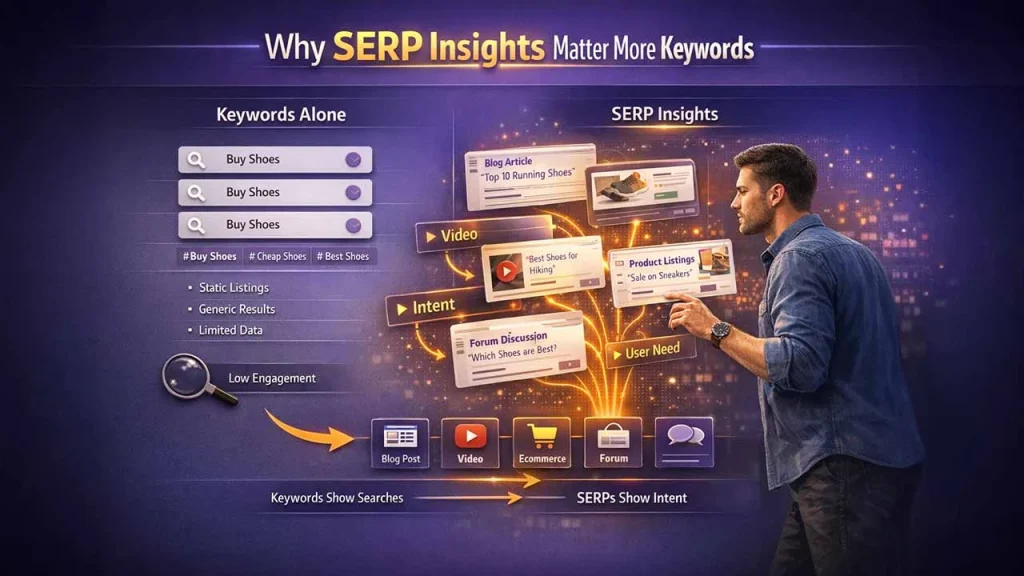
Finding keywords, putting them in the right places, and repeating them carefully were all important parts of SEO for a long time. Keywords are still important, but they don’t tell the whole story anymore. Today, search engines reward relevance, intent alignment, and usefulness — not just keyword presence.
SERP insights matter because they show how Google interprets a query right now. When you search a keyword, the results page reflects Google’s understanding of user intent. Are people looking for definitions, comparisons, tutorials, tools, or opinions? Keywords alone can’t answer that but SERPs can.
For example, two keywords with similar volume may produce entirely different SERPs:
- One may show blog posts and guides
- Another may show product pages, videos, or forums
This tells you something critical: Google expects different content types. SERP data reveals these patterns clearly, helping you align with that expectation instead of fighting it. In short, keywords tell you what people search. SERP insights tell you what kind of answers they want.
Key Elements to Analyze for SERP Insights
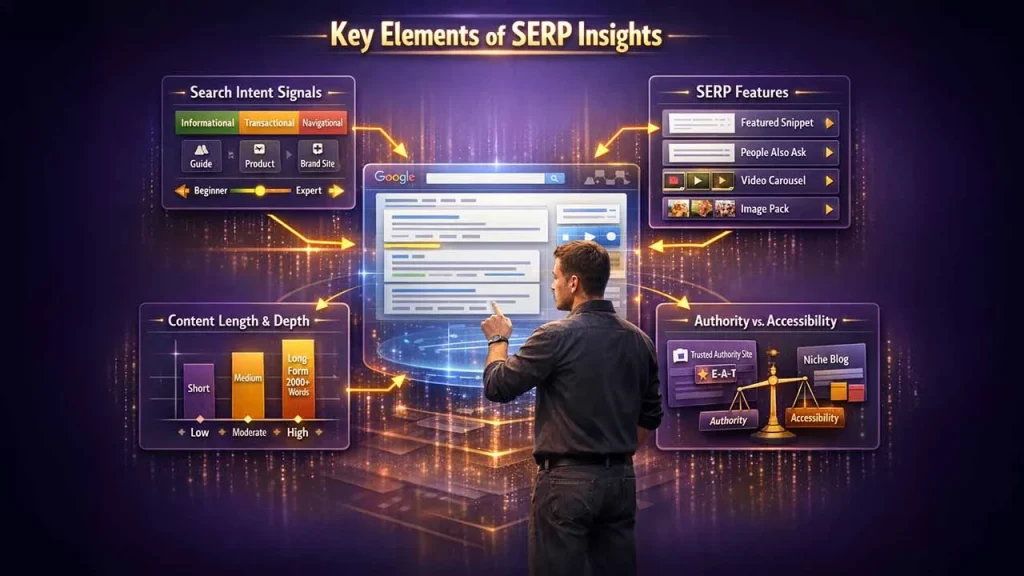
You must look beyond rankings to discover what search results are actually telling you. The SERP’s recurrent elements disclose content expectations, format preferences, and intent. Effective SERP analysis requires examining multiple layers of information.
1. Search Intent Signals
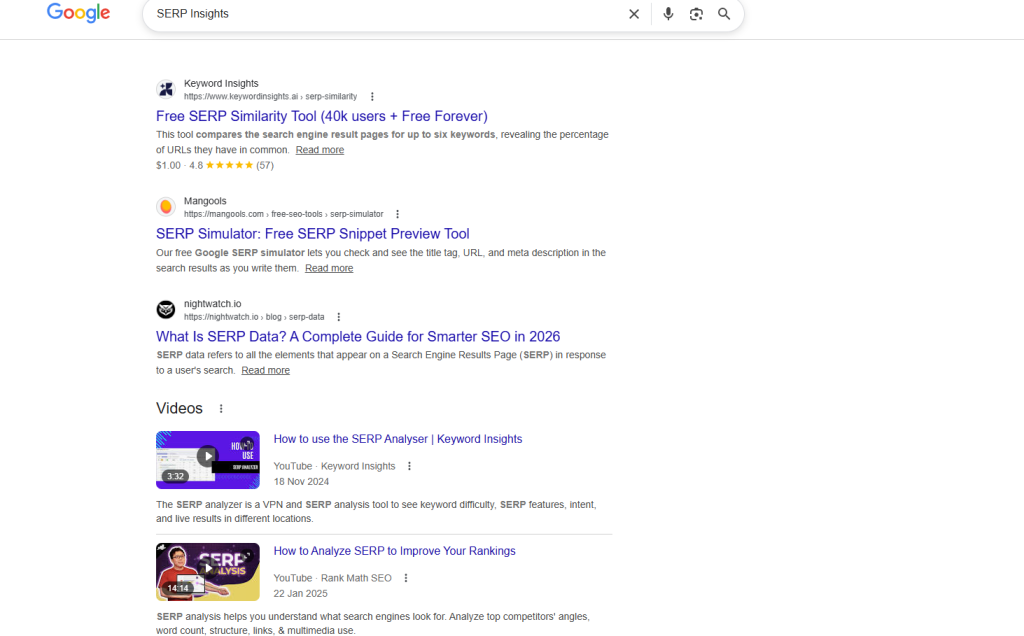
Look at the top-ranking results and ask:
- Are they informational, transactional, or navigational?
- Are they beginner-friendly or expert-level?
- Are they tutorials, comparisons, or opinion pieces?
If the top results are “how-to” guides, a product landing page won’t survive there—no matter how optimized it is.
2. SERP Features
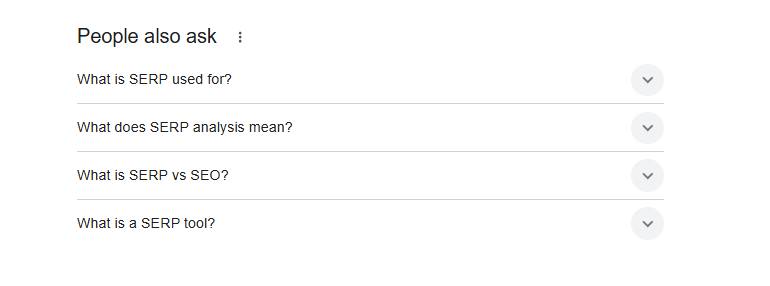
Featured snippets, People Also Ask boxes, videos, and image packs are clear signals of how users prefer information.
For example:
- A featured snippet suggests users want fast answers
- A video carousel signals visual learning preference
- People Also Ask reveals follow-up questions worth addressing
Ignoring SERP features is like ignoring signboards on a highway.
3. Content Length and Depth Patterns
SERP insights often reveal a content length range that performs best. If:
- All top results are 2,000+ words, then it means that shallow content won’t rank.
- Top pages are concise then long-form might be unnecessary.
This isn’t about copying competitors; it’s about matching expectations.
4. Authority vs Accessibility
Sometimes SERPs are dominated by big brands. Sometimes they’re filled with niche blogs. This tells you:
- Whether authority matters more than originality
- If there’s room for smaller publishers
- What level of expertise Google expects
It helps you decide whether a keyword is worth pursuing at all.
5. (AIO) AI Overviews
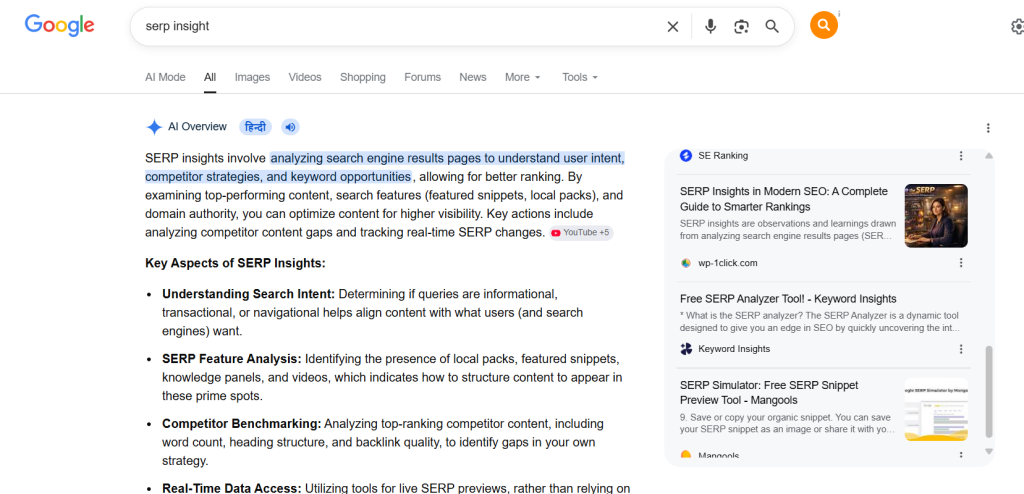
AI Overviews appear at the very top of Google’s results page. It gives users a summarized answer generated directly from multiple sources. When this feature shows up for your target keyword, it means Google is confident enough to synthesize an answer itself. Your content needs to be clear, well-structured, and factually reliable to have any chance of being pulled into it.
6. Paid Search Ads
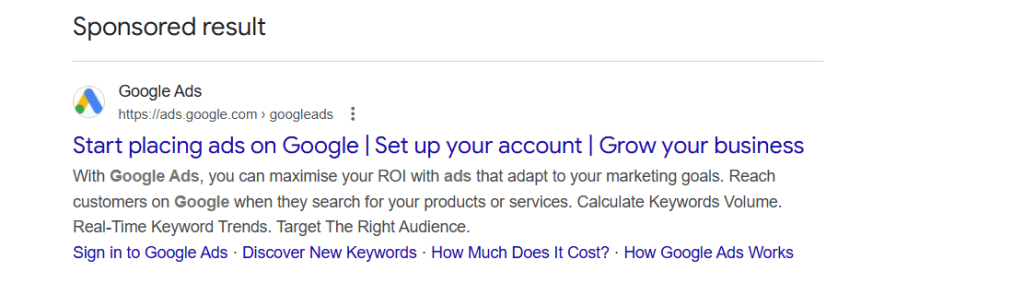
When paid ads dominate the top of a SERP, it signals strong commercial intent behind that keyword. If multiple advertisers are spending money on a query, it usually means users are not just browsing, but they are ready to buy. This signal is useful for deciding whether to pursue a keyword organically or accept that the top spots will always be paid placements.
Organic Search Results (Blue links)
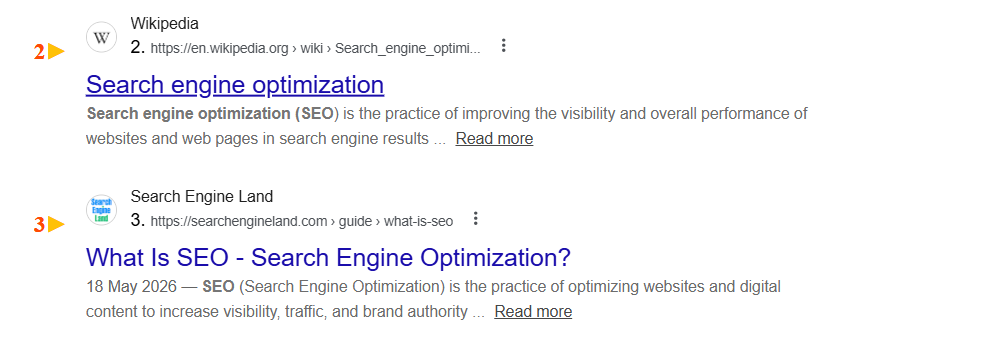
Organic results are still the backbone of any SERP. Pay close attention to what types of pages rank; are they product pages, long-form guides, comparison articles, or homepages? The format and source of organic results tell you exactly what Google considers the most relevant answer, and that should directly shape how you structure and position your own content.
Featured Snippets
A featured snippet refers to Google pulling a specific answer out of a page and displaying it above everything else. If a snippet exists for your keyword, it means the query has a clear, definable answer. Structuring your content with direct answers, concise definitions, or numbered steps increases your chances of capturing that position which can significantly boost clicks even without ranking first. Run a quick SERP insight check to confirm whether a snippet opportunity exists before structuring your content around it.
Local Pack
SERP insight tells you upfront whether local intent is dominating results for your keyword. The local pack shows a map along with three nearby business listings. It appears when Google detects location-based intent in a search. If the local pack shows up for your keyword, it is a strong signal that users want results near them. For businesses with a physical presence, optimizing your Google Business Profile becomes just as important as any on-page SEO effort.
How to Conduct a SERP Analysis Step by Step
Start by searching your target keyword in Google and reviewing the first page of results. Look beyond the ranking positions and examine the type of pages appearing, their content format, search intent, headings, and the SERP features displayed.
Next, identify patterns among the top-ranking pages. Check whether Google is favoring detailed guides, comparison articles, product pages, videos, or other formats. Look for common topics covered by several competitors, but also note questions or information that appear to be missing.
It is also useful to compare the quality and structure of competing pages. Consider whether they provide clear answers, practical examples, useful visuals, or easy navigation. These observations can help you create something more helpful instead of simply copying what already ranks.
For technical topics, understanding concepts such as Data Structures can also help you evaluate whether competing content explains complex subjects clearly and logically. The goal is not to reproduce another website’s approach but to identify opportunities to provide a more complete and useful answer.
Finally, record your findings before creating or updating content. Look at the search intent, dominant content format, important subtopics, SERP features, and potential content gaps. This gives you a practical roadmap for building content that better matches what users are searching for.
Real-World Uses of SERP Insights
SERP insights directly influence better choices; they are not merely for analysis. When used properly, they enhance competitive positioning, optimization, and content production. Collecting and interpreting SERP data strategically can transform your entire content approach.
Creating Better Content
Instead of guessing what to write, SERP analysis shows:
- Which questions to answer
- What subtopics to include
- What tone and depth are expected
This results in content that feels naturally aligned with search demand. Whether you’re planning how to start a blog or optimize existing pages, this approach ensures relevance from the start.
Improving Existing Pages
If a page isn’t ranking, SERP insights help diagnose why:
- Wrong intent
- Missing sections
- Weak structure
- Outdated angle
You can update content strategically rather than rewriting it blindly.
Content Planning and Topic Clusters
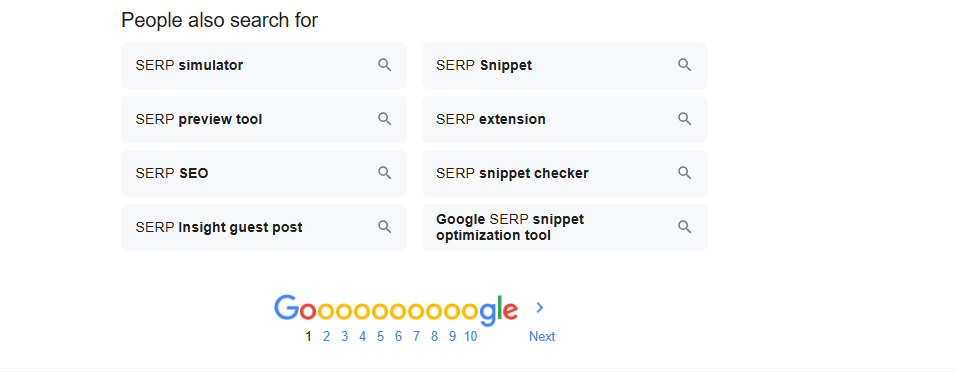
SERPs reveal related queries through:
- PAA boxes
- Related searches
- Repeated subtopics across ranking pages
These insights help build strong internal linking and topic clusters.
Competitive Analysis
Instead of copying competitors, SERP insights help you:
- See what everyone covers
- Identify what’s missing
- Offer a clearer, more useful version
That’s how content stands out without being gimmicky.
How to Use SERP Insights to Find Content Gaps
A strong SERP analysis should not end with identifying which pages rank. It should also help you discover information that users may still be struggling to find. Content gaps can appear when ranking pages overlook important questions, provide outdated information, or fail to explain a topic in a clear and practical way.
Start by comparing several top-ranking pages and listing the major topics they cover. Then look for differences between them. If users are asking related questions that are not answered clearly, those questions can become valuable additions to your content.
You can also examine SERP features such as People Also Ask and related searches to discover additional topics. These signals can reveal what users want to know next and help you build a more complete article rather than focusing only on the primary keyword.
Visual content can be another useful gap to consider. If competing pages explain a technical or comparison topic almost entirely through text, adding relevant screenshots, diagrams, or image guidance may make your content easier to understand. For example, when discussing image formats, a related resource such as WebP vs JPEG vs PNG can provide readers with additional context without interrupting the main discussion.
The goal of content-gap analysis is not simply to make an article longer. It is to make it more useful. Focus on answering unanswered questions, simplifying difficult concepts, adding practical examples, and providing information that genuinely improves the reader’s experience.
Common Mistakes People Make with SERP Analysis
Even experienced marketers misuse SERP data. Some of the most common mistakes include:
Focusing Only on Rankings: Ranking positions alone isn’t enough to explain why a page ranks. Ignoring elements like intent, structure, and SERP features leads to shallow conclusions.
Ignoring SERP Volatility: SERPs change constantly. A keyword that once favored blogs may later favor videos or tools. That’s why failing to revisit SERPs regularly can lead to outdated strategies.
Copying Instead of Understanding: Blindly mimicking top-ranking pages without understanding the context results in repetitive content. SERP analysis should guide better decisions, not duplication.
Overlooking User Experience: Many focus on keywords, but they ignore important factors like readability, layout, navigation ease, and page clarity. These factors strongly influence performance.
Treating SERP Analysis as a One-Time Task: SERP insights are ongoing. However, when you treat them as a one-off checklist, you risk limiting their value.
How SERP Insights Improve Long-Term SEO
SERP-driven tactics prioritize alignment over short cuts. This strategy creates content that consistently performs even as trends and algorithms change. when you use SERP insights to create content:
- Bounce rates drop
- Engagement improves
- Content ages better
- Updates become easier
- Rankings stabilize instead of fluctuating
You stop fighting Google and start working with its logic.
How SERP Insights Support On-Page and Off-Page SEO
SERP insights are most valuable when they guide both your on-page and off-page SEO efforts. By analyzing the top-ranking pages for a target keyword, you can identify what search engines prioritize and adjust your strategy accordingly.
For on-page SEO, SERP analysis helps you optimize title tags, meta descriptions, headings, content depth, internal linking, and schema markup to better align with search intent. It also reveals the types of content—such as guides, comparisons, or listicles—that consistently perform well for specific queries.
On the off-page side, SERP insights can uncover the authority level of competing websites, backlink trends, and brand mentions that contribute to higher rankings. This information helps you develop a more targeted link-building and digital PR strategy.
To build a well-rounded SEO strategy, it’s important to understand the differences between On-Page vs Off-Page SEO and how each contributes to improving visibility in search results. Combining both approaches with accurate SERP analysis gives you a stronger foundation for long-term organic growth.
How to Measure SERP Success
Using SERP insight is one thing but knowing whether they are actually driving results is another. The below mentioned are three areas that are worth measuring:
Visibility: Start by measuring where your pages appear and how often. Visibility metrics tell you exactly how Google sees your content relative to the query at any given point.
- Track average ranking positions for target keywords over time.
- Monitor appearances in SERP features like featured snippets, PPA boxes, and video carousels.
- Watch your share of voice against competitors week over week.
- Note when a page loses a SERP feature.
Engagement: Ranking alone doesn’t reveal the full story. These metrics show whether your SERP presence is actually earning attention, not just impressions.
- Track click-through rate (CTR) by page and keyword.
- Compare your CTR against average benchmarks for each ranking position.
- Monitor dwell time to see if users are finding what they came for.
- High bounce rate on a well-ranked page often signals an intent mismatch worth fixing.
Business Metrics: This is where SERP performance connects to real business outcomes. Traffic numbers feel good, but organic traffic that doesn’t convert is just a vanity metric.
- Map SERP improvements directly to leads, sign-ups, or sales over time
- Track conversion rates by organic traffic source, not just overall volume
- Identify which SERP features from snippets, PAA, local pack are driving the highest quality visits
- When rankings improve but conversions don’t follow, revisit the page’s intent alignment
SERP Insights vs Traditional Keyword Research
Researching keywords reveals what people look for, but it seldom explains how those searches are fulfilled. SERP insights bridge that gap. Comprehending this distinction aids in bridging the gap between actual ranking success and traffic potential.
| ASPECT | TRADITIONAL SEO | SERP INSIGHTS |
| Primary Focus | Focuses mainly on search volume and keyword metrics. | Focuses on understanding user intent using search results & SERP data. |
| Content Direction | Guides what keyword to target | Reveals format, depth, and angle Google prefers. |
| Nature of Analysis | Largely static and tool driven. | Dynamic & based on real-time SERP behavior & patterns. |
| Ranking Strategy | Aims to place keywords strategically in content. | Align content fully with search intent & SERP expectations. |
| SEO Outcome | Helps identify opportunities but may miss intent mismatch. | Helps create content that naturally ranks & engages users |
The best strategies combine both, but SERP insights often decide whether keyword research succeeds.
The Future of SERP Insights
SERP insight is becoming increasingly advanced, with search engines using many more factors than previously thought. The way search engines evaluate user satisfaction, recognize user intent, and context; SERPs will continue to evolve into highly personalized, dynamic result pages. Changes are evident to how visibility is created due to the introduction of features such as AI-generated overviews, conversational search, multimedia results, and intent-based clustering.
This means SERP insights will increasingly focus on understanding why certain formats appear, how users interact with them, and what Google considers genuinely helpful at that moment. Instead of chasing algorithm updates, marketers and content creators who master SERP analysis will adapt naturally by aligning content with real user needs, search behavior patterns, and emerging result types.
Final Thoughts
SERP insights are more than just reviewing rankings or replicating content from the first page. They call for strategic thinking, observation, and interpretation skills that develop with practice rather than plugins. Anyone can look at search results, but only effective SEOs will know why certain pages appear high in SERP ranking and how their associated searches are rewarded by Google and how user intent is changing.
The search results are rapidly evolving with AI-powered summaries, richer features, and focus on intent-driven layouts. Thoughtfully analyzing the search engine results pages (SERPs) gives SEO professionals the ability to think like a user as well as a search engine, which is essential to mastering SERP insights. This dual perspective transforms SEO from a checklist into an ongoing strategic benefit.